Woke Politics and the Crippling of the Centre-Left

Potholes

Western liberal societies have fallen into an ideological hole in the road. We have been stuck in it for some time but have registered the fact only recently, because other problems have developed that are easier to measure. The pillars that underpin our high standards of living have been eroded to a point that is collectively noticeable. After decades of abundance, the food, the water, the transport networks, the postal service, medical and social care, housing, our artistic culture and social cohesion – they have all begun to turn.

At the same time, strange scenes are observed in daily life and reported in the media. At work, rules proliferate like weeds, strangling creativity in the name of safety and inclusivity. Friends can permanently incriminate themselves with a word – and an uneasy quiet reigns in many homes and public fora, where doublethink is considered essential to morality and suspected thoughtcrime is punished by “cancellation”. As record numbers of young people claim treatment for mental health issues, the atmosphere of tension and uncontrollable weirdness reaches into the theatre of politics, where flagrant charlatans are elected and re-elected to positions of high office.

If asked, many Westerners would point to Donald Trump and his supporters as the worst symptoms of our current affliction – not so I. I think the worst and most dangerous product of our times is the body of extreme, quasi-liberal ideas called “woke”. I say this not simply because it is an ugly, reductive, solipsistic philosophy that is damaging to thought, but – still more importantly – because it is the woke movement which has killed the political Centre and thrown lighter fuel on the bonfire of Populism.

Collapsing the Centre

When you find yourself in a hole, there is a tremendous temptation to hunt around for someone to blame. The Right blames the Left, the Left the Right, philosophers blame other philosophers, the woke blame the unwashed, unenlightened masses or a cabal of evil billionaires and the un-woke blame the woke or they blame immigrants. In short, we blame anyone but ourselves and then go back to our screens.

On the Left in particular, there is a tremendous hand-wringing and defeatist bemoaning of Trump. Woke liberals think the current state of politics is entirely the fault of people like him. They do not see that they are the main reason Trump was elected and then re-elected, nor that it is now their responsibility to evict him. It was the woke movement which produced an environment of debate so hostile that the only people who could survive in it were unshockable demagogues on the Right or the most vacuous, insipid species of Left-leaning politician. Ultimately, the only loud voices who could voice an opinion contrary to the woke position were politicians like Trump and Farage. And so the populist Right gained legitimacy, because it was the sole voice of common sense. Now, instead of a sympathetic discussion of trans rights, Americans are presented with a President who is completely deaf to them. And instead of having a reasoned debate about immigration in the UK, we face the prospect of a Reform government that seeks to stifle it almost completely. Essentially, the intolerance of the woke position has produced an equally extreme reaction on the opposite side of the political divide. When they killed off any high-level debate by calling their opponents racists and TERFs, woke liberals immobilized the political moderates. There was therefore no one to apply friction when the pendulum of public opinion began sliding the other way.

On the Left and Centre of UK politics we have political parties like the Greens and SNP, which were originally formed to bring major issues like climate change and Scottish national sovereignty to the forefront of the national agenda. Today, many of these parties are riven with internecine conflict, where your position on gender identity is critical to your political future. In 2019, a third of all internal motions tabled by the Green Party related to trans rights. Variation from the woke orthodoxy can be met with a “no-fault suspension” and eventual expulsion from the Green party, with more than 40 men and women having been evicted for putative “transphobia” to date1.

In many parts of the western world, we are witnessing a movement towards a more autocratic style of government. The woke cannot understand it at all, because they see it as the result of “bad actors” instead of a natural response to societal changes and their own hypocrisy and intolerance. Fascism, like any popular movement, has its origins in certain truths of human nature. The fascist dreams of a greater and nobler people who grow by experience and toughness. It is only natural for a society that prioritises safety and mediocrity to give rise to a yearning for its opposite. As votes continue to move to the Right, the average woke liberal lives in a state of perplexity, shocked by the repeated electoral success of politicians like Johnson, Trump and Farage.

Woke or Liberal?

A current of ideas has developed in the Western middle class that is markedly different from the liberal ideology that dominated at the end of the 20th century. Woke thought became obvious as a political force during recent public debates, though they developed over previous decades, culminating in a society where health and safety and political correctness have “gone mad”. The debates covered a range of topics, including:

(i) What “additional” rights and privileges – if any – should be accorded to transgender people?

(ii) Should we destroy artistic, economic and intellectual links to our colonial past?

(iii) What is a reasonable immigration policy when the UK has contributed to the collapse and impoverishment of foreign regimes?

The woke reaction to these debates came violently, like bubbles bursting at the surface of deep water. People politely advancing counterarguments, or calling for further thought before policy decisions were made, were told they were killing people, were shouted down, or were told they were as immoral as individuals on the extreme right of politics (who were just as outspoken as the woke apologists and who really did hate immigrants and transgender people). As the debates continued, woke attitudes became influential and many were integrated into the way society is run. We are now “profiting” from those changes in a culture of extreme censoriousness and “inclusivity”, where the political landscape has been hollowed out at the centre and power begins to concentrate in the wings.

My personal experience of the transition away from liberal values comes from conversations with the highly educated, scientifically-literate middle class and from working in a non-departmental public organisation. In the past five years, I have witnessed behaviour that would have been considered shocking twenty years ago. I have watched educated friends quiver with rage as they mount the most poisonous, vitriolic attacks on writers whose work they have never read and I myself have been reluctant to discuss topics in polite company for fear of being misunderstood.

When speaking about woke ideas, or “woke people”, it is vital to be clear about what we mean. The woke community is large and diverse – though almost exclusively middle class. Most of my colleagues and social acquaintances proudly consider themselves woke, so it is straightforward enough for me to outline their political views2:

On transgender people: A man is a woman if he thinks he is (and vice versa). If you do not think that a trans man is literally a man then you think trans people are lying and you are transphobic. Anyone who disagrees with, or is unsure about, the rights/privileges3 demanded by the transgender lobby is a TERF (a trans-exclusionary radical feminist). TERFs should not be spoken to or engaged with because all the necessary information about trans issues is available online and they should therefore know better. TERFs should not be allowed to speak in public spaces because it scares trans people and anything short of immediate acceptance of trans proposals is equivalent to killing trans people. Any discussion of trans rights is equivalent to the most egregious form of hate speech. Scepticism of transgender rights is precisely analogous to homophobia.

On immigration: Everyone is welcome forever, with no limits. If you would like to reduce immigration – or want to discuss changes to the existing rules – then you are a racist. Someone who wants to reduce the number of immigrants in the country is against asylum seekers. Someone who is against further immigration hates the existing immigrant communities in Britain.

On art and fashion: In art, politics is more important than aesthetics. Anything can be good art, regardless of how crapulent its execution, provided its politics are woke. You are not responsible for the psychological impact of your appearance on other people. It is not possible to dress provocatively. Comedy is only funny if it is inoffensive to woke people. The prevalence of the female form in art is an unfortunate consequence of male power that should be corrected. Ugly is beautiful.

On history and education: previous generations and cultures should be judged against woke values. These values are correct because they reflect the views of the nicest and best-educated people, living in the most rational and technologically advanced society there has ever been. White men are disqualified from talking about issues of racial equality and women’s rights because they have not directly experienced sexual or racial oppression themselves and because they continue to occupy a position of power in society. Education should be “de-colonized”. Children should be free to choose what they eat, how they dress, how to learn, how to behave, what sex they identify as, because these choices allow them to express their “true self”.

On crime and punishment: Extenuating circumstances do not exist for certain crimes. For example, all forms of rape are uniformly bad. The role of a court judge is to assess whether or not a crime has been committed – not to evaluate the harm occasioned or the degree of culpability. Laws reflect eternal truths of justice, instead of representing an ad hoc used to bridge a grey area. Imprisoning people is wrong. Celebrities should not be allowed to criticize trans issues on Twitter because they are too influential. No form of sexual attraction is “wrong”, so long as it is consensual.

On the vote: Anyone from the age of 16 upwards should be able to vote.

Frequently presented with the éclat of self-evident truisms, none of these ideas are. Most are extrapolations of liberal ideas into new contexts where they should not apply, based on a simplified conception of humanity that does not exist. If you are wondering why I haven’t included other examples of woke thought – those that might be considered more unambiguously positive – it is because these ideas were already present in the liberalism of the 20th century. What marks the woke movement out from classical liberalism are precisely those ideas listed above, eloquent as they are of the preoccupations of the contemporary bourgeoisie, with its tribalism, selective sympathy, rejection of personal responsibility and fanatical resistance to dissent or debate. John Gray uses the term “hyper-liberal” to describe these views and I will use “woke” and “hyper-liberal” interchangeably throughout this essay.

Unlike liberalism, which grew out of the community-based, grassroots activism of a working class, woke ideas were disseminated online by a bourgeoisie that is increasingly socially isolated and technocratic. Where liberal ideas were shaped over centuries, culminating in the suffrage and civil rights movements of the twentieth century and the progressive social policies of the postwar era, hyper-liberal woke ideas developed amongst the Western middle class in the early twenty-first century, steeped in a climate of postmodernism and free-market capitalism, where community feeling was weak, privatisation and consumerism were strong and people’s perceptions were increasingly shaped by what they observed on their mobile phone screens. The middle class expanded hugely in this period and it is no surprise therefore that the dominant ideology of our time is essentially a defense of middle class attitudes and living habits, where the Self is positioned at the top of the cosmic hierarchy of importance.

Transitioning to Woke

“I think there are good things about [the internet], but there are also aspects of it that concern and worry me. This is an intuitive response – I can’t prove it – but my feeling is that, since people aren’t Martians or robots, direct face-to-face contact is an extremely important part of human life. It helps develop self-understanding and the growth of a healthy personality.

“You just have a different relationship to somebody when you’re looking at them than you do when you’re punching away at a keyboard and some symbols come back. I suspect that extending that sort of abstract and remote relationship, instead of direct, personal contact, is going to have unpleasant effects on what people are like. It will diminish their humanity, I think.”

Noam Chomsky, How the World Works – p. 167.

While it is tempting to look on hyper-liberalism as a malady born of a single cause, the reality is probably more complicated. Although there have been instances where individuals have had a disproportionate impact on the direction of a country, political movements seem to grow more often from a mixing of economic and cultural factors; as the fruit of many mechanisms, interacting together and amplifying in a non-linear way. Most of the time, the best we can do is to trace the history of ideas without trying to advance any general theory about how they are developed. That said, I would like to propose two factors – one technological and the other economic/ideological – that I think have had a strong influence on the transition from liberalism to woke. I think they have done this by eroding community-feeling in Western liberal societies, while enhancing our personal autonomy/independence. Living in densely populated urban environments, without the ties brought about by shared values, traditions or religious beliefs, in a society that actively seeks to reduce face-to-face social interaction, I think we have become more asocial, our perceptions have narrowed, and we have started to develop the selective sympathy that is the ensign and hallmark of all despotic regimes.

The woke movement was born just as the digital generation (those who grew up with access to the internet) matured and began to broadcast their political views online. Our reliance on digital technology has changed the way people socialise and work; it has created megacorporations of profound influence, radically altered the composition of our high streets, changed the way people relax and the way they assimilate information. The result of this compression of the social sphere is that we have become more insular and neurotic. It is common to hear about how media algorithms and online networks have connected individuals with extreme right-wing views together – people who would ordinarily find little traction for their radical ideas. But there is no reason why the mechanism should operate only on the Right. The same process has been active on the Left for the same amount of time, contributing strongly to the growth of woke by uniting the voices of the most anxious and isolated members of our communities.

Working in concert with digital innovation, economic forces have contributed to the dominance of postmodern cultural relativism in the late 20th century. It is this nihilistic ideology – an important component of the hyper-liberal outlook – that has accentuated the social isolation brought about by technology. In the late 20th and early 21st century, “free market” economic policies were adopted in the UK with campaigns of privatisation and deregulation. This allowed companies and banks to develop as centres of political power, tying decision-making at a national level to the financial markets and weakening key public services that were previously a source of pride and trust. Other economic pressures led to geographically-concentrated immigration and the collapse/export/sale of British industries. At the same time, a “consumer culture” took hold as the middle class expanded and cheap holidays and products flooded the market. The result is a society where the middle class feel more insecure and entitled than they did before. They do not understand the motivations of others – even their immediate neighbours – who do not share their views and they look for support online, in interest groups, in identity politics, or in the oblivion of streaming services.

The liberal nihilism that developed into woke is a state of minimal artistic and political energy4:

“…You believed in things because you needed to; what you believed in had no value of its own, no function… A dog scratches where it itches. Different dogs itch in different places.”

As Gray observes, its insistence on the subjectivity of opinion renders all old values meaningless and offers nothing in return. Moreover, it has eroded the sense of community that comes from local, national or religious affiliation. When national pride is written off as jingoism, religion as mere superstition and government officials as institutionally venal and incompetent, there are few places left in which people can place their loyalty and their trust. Of those that remain, most have already been undermined by new patterns of socialising brought about by technology.

The nihilism of a modern Western liberal democracy did not allow technology to be controlled as it has been, at various times, in Asia. Since nihilism volunteers no ethical framework of its own, people have to cling to the disintegrating flotsam of their cultural traditions. With no existing ideological forces to limit the use of new technologies, these technologies were free to shape our behaviour unchallenged. Probably the most potent symbol of human behavioural change is the ubiquity of “smartphones”, which now live permanently in our pockets and by our bedsides, insinuating their way into our lives as “omni-tools” of convenience.

These technological and economic changes, the repercussions of which have built gradually over decades, have left people feeling isolated and weak. Without community, governments and big companies appear invincible – even democratically-elected governments. The sense of helplessness incurred then reinforces the importance of preserving one’s own interests. People watch the insidious decline in living standards, but do not know what to do. They are not used to acting on their own and they see no existing power structures that could help them.

I have suggested there may be a link between woke ideas and the erosion of community-feeling in Western Liberal societies. If true, we can adumbrate a chain of causation by looking for ways that communities have fragmented and face-to-face social interactions reduced in recent decades. An important task will be to examine how technology influences society in general terms. Much of the work will fall to psychologists and sociologists to probe deeper into the effects of digital tools on our way of thinking, though we can look to the work of major 20th century writers for clues. Orwell and Huxley saw that technological progress should be controlled to keep certain benefits while avoiding a mechanical utopia peopled by machine-minded technocrats. Orwell felt that this could be achieved in a modern socialist democracy, but that it was the socialists themselves who were the main obstacle to getting broad support for a socialist government. Huxley thought very seriously about how a modern utopia might be constructed, before concluding that it wouldn’t be possible in the international climate of the day. He felt that without some form of protection, countries with weak militaries would be exploited by their stronger neighbours (homo homini lupus est). McLuhan saw that the effects of these new media technologies – once generally adopted – would be far-reaching and devastating. He observed that humans have few defences against tools that change the pattern of human thought when they are used.

The Self Above All

“…But you see, it’s not me, it’s not my family
In your head, in your head, they are fighting…”
Zombie – The Cranberries.

In the closing decades of the 20th Century, when God and duty were killed and our ministers of government shown to be corrupt, man was given the “freedom” to choose his own allegiances. It was then that the Self grew to insalubrious prominence and the liberal project was superseded by a more self-centred, hyper-liberal perspective.

We see this selfishness particularly in the extremity of the hyper-liberal reaction to those who disagree with them. For the woke individual, when they say they are feeling “triggered” or “uncomfortable”, they are making a unilateral statement that justifies the extremity of their response. The statement does not consider the feelings of others – it is their own emotions that count. This is true not just in the context of the debate over trans rights. Many people today consider personal feelings to have a kind of sacred importance. They think reality conforms to what is sincerely believed. But just because a feeling is real doesn’t imply that it corresponds to something that is physically true. There are innumerable everyday scenarios where we call out other people when we deem their feelings inappropriate, where their behaviour is not commensurate with reality, or they are simply mistaken. We are all fallible. It is not unjust to say that someone is overreacting, particularly if they are known to be oversensitive or to have outstanding mental health issues. Nor is indulgence always a kindness, which should be obvious to anyone who has spent time in the company of spoiled children. Good parents don’t waste time trying to prove scientifically that a child’s response is disproportionate or that their feelings – though real enough – are unjustified. They know instantly and intuitively that the response is absurd. It is measured against our values and our knowledge of how people normally behave. Yet there are many hyper-liberals who would disagree – who believe that reality conforms to hyper-liberal opinion on topics as diverse as biology and socioeconomics.

I once went to a vernissage at the CAPC musée d’art contemporain in Bordeaux where a trans woman artist was singing. Though they identified as female, the artist was physiologically male – and I have since forgotten their name, so I will refer to them here as M-. During the performance, I remember being transported by the beauty of M-‘s voice and the music. Before “she” began, however, M- received our welcome applause and said how grateful she was, because she had just walked up the Rue Sainte-Catherine (Bordeaux’s 1.2 km-long high street) and been subjected to laughter and comments. She was, as I recall, wearing a frilled mini skirt, fishnet stockings, platform heels and a corset – all in silver or metallic bluish-purple. The crowd’s response was predictably outraged and shouts of support merged into a sympathetic ovation.

My own response to M-‘s experience was more conflicted. Certainly no one wants to be openly laughed at, or to have comments directed at them in the street. I consider it a fact of life, however, that if a man puts on a corset and heels and walks down the busiest thoroughfare of a major city then they are going to attract unwanted attention. Essentially, someone dressed in a striking and unusual – dare I say even amusing – fashion was upset by the reaction of the general public. But oddities obtrude. And pretty women have to contend with similar levels of discrimination (positive and negative) throughout their lives – short skirt or no. For the most part, they learn to bear this discrimination with admirable stoicism. They understand that there are types of discrimination which cannot be erased without the most appalling tyranny and the destruction of humans as social animals.

Personally, I don’t see M-‘s experience as evidence that transphobia is rife in Bordeaux or that trans rights should be brought to the forefront of France’s national agenda. I think rather there is a tension between M-‘s desire to be noticed – to be at the centre of a spectacle – and to be treated the same as everyone else. This tension also appears more generally within the transgender community. On the one hand there is a desire to be singled out for special awards, to have specialized support groups and constant verbal and written acknowledgement of their distinctiveness, while on the other hand they want to be seen as completely normal. If it means we have to disrupt the smooth functioning of the rest of society to chase a logical inconsistency – even down to policing what people are allowed to say and think – then it seems hyper-liberals are happy to do so.

When hyper-liberals hear about experiences like M-‘s, they are apt to conclude that not only has great harm has been done but that society is transphobic. The reality, however, is that hyper-liberals communicate with “transphobes” primarily via the internet. In their day-to-day life, they are surrounded by other middle class people who fully support the trans lobby. It is only on the very fringes of society that genuinely transphobic sentiment is found. The overwhelming majority of other people don’t care how transgender people identify so long as they can just get on with their lives as normal. The world looks very different to a hyper-liberal, however. Peering through the narrow aperture of their Twitter feed, the world seems remarkably hostile. Words and images develop a dizzying potency when they are beamed directly and repeatedly into one’s own home. Eventually everyone – everyone – becomes overly sensitive. Then on the rare occasion that someone suggests our time and money would be better spent tackling issues like the job market, or climate change, they are told in an outraged tone that “people are dying” – as though it has nothing to do with the transgender people themselves and their own insecurities.

The self-centredness of hyper-liberal opinion is likewise clear from their position on major political issues like immigration. Immigration is now sufficiently important to the British public that many consider it to be the most significant public issue – even greater than climate change or “the economy”. This is clear from the results of recent council elections, where Reform UK won the largest number of seats. Hyper-liberals, by contrast, not only do not consider it important but see any discussion of immigration laws as evidence of racism.

The tedious length and bitterness of the immigration debate comes principally from a difference of perspective. In many parts of the UK, local people see that the substance of their towns and cities is changing. They see foreigners in the streets who do not have (and shouldn’t be expected to have) British habits of living. They read that factory and farm workers come here temporarily to earn money and send it abroad, then they read about boats full of desperate migrants trying to enter the country from France or foreign investors buying up property in desirable locations. Many respond to this situation by blaming immigration laws, which they feel are too lax.

Hyper-liberals on the other hand observe no significant changes brought about by immigration – that is, no changes that they cannot easily cope with or do not benefit from themselves. They live in areas that have seen little in the way of demographic change or economic hardship. Their money insulates them from those parts of town where low-paid immigrants live beside the most deprived members of British society. Like everyone else, they live largely online, in the narrow space between their noise-cancelling headphones and computer screens. Their interaction with immigrants is therefore limited to the highly-educated individuals they meet at university (who are essentially indistinguishable from themselves, having retained little of their parent culture) or the anonymous multitude that delivers their pizza and Amazon parcels. They have read about the United Kingdom as a colonial power, with its piebald history of racist domination, and they suspect that Reform voters either don’t know this or are too unpleasant to consider it. They assert that studies have shown (i.e. eternally and conclusively) that immigration is economically beneficial. To want to discuss a new policy is seen as evidence of racism.

In fact, there is always an upper limit of immigration that a country can support. No country can withstand unbounded immigration. The reality – acknowledged by all governments – is that immigration brings benefits and challenges that must be weighed. When Western liberal countries make decisions about immigration policy their concerns are largely economic, though other countries exist – like Japan – that are more ethnically homogeneous, where the public perception of immigrants is less favourable and immigration is kept low even to the detriment of the economy5. The right attitude to immigration depends on the socioeconomic context. In the UK, it might be argued that our history of intervening in the government of other countries imposes on us a duty to welcome more immigrants than might be considered desirable or “beneficial”. But there are many other factors to take into consideration as well – ministers must balance our need for carers, laborers and agricultural workers against other factors, such as the ability of the UK’s infrastructure and welfare system to support more people.

The complexity of the immigration issue can be appreciated via simple thought experiments. Consider, for example, a society where the working class has shrunk and the inflated middle class is increasingly employed in technical and bureaucratic roles. Suppose also that the offspring of the middle class aspire to jobs in science, medicine and law that require extensive training (e.g. postgraduate degrees). In this situation, how is society to continue to function without immigrant carers, farm laborers and factory workers? We can also consider a scenario where the country has a growing population that is too large for it to support. Existing stresses on housing and public services are worsened as more people arrive in the country and high levels of immigration in certain areas (combined with an economic depression) exerts a psychological strain on local people. Perhaps there are problems in specific sectors of the economy- for example, there may not be enough training positions for postgraduate medical students, who are competing against tens of thousands of peers and international graduates for a few thousand places. How, in this situation, is the country to cope without limiting immigration?

Contemporary Britain is a sort of convolution of these two pictures, which means the solution is neither unbounded immigration nor closed borders. Many of the problems attributed to excessive immigration in the UK are economic at root. Though they are related to immigration laws, they are driven primarily by the pressure to produce cheap services and commodities. An open and ongoing discussion is needed to maintain a healthy immigration policy and, as with all political discourse, the discussion cannot be open if it is not respectful. The woke assertion that there should be no limits to immigration and the only problems related to immigration stem from the number of racists in Britain is absurd and only serves to strengthen the political influence of Reform.

It seems reasonable to me that selfishness is responsible for many of the more unpleasant woke ideas because the reaction to woke amongst many young people of the same class is equally selfish. Go to any city in the country and you will find a young middle class man who, upon seeing someone in a more unfortunate position than himself, will remark in a self-satisfied tone that the man has made his choice, that there are other jobs you can do, that people are lazy and the important thing is to make money and look after yourself. You will see that there is some truth in what he says – that society has become obsessed with easy living and quick returns and supporting everyone irrespective of merit – but you will also note the scorn in the man’s voice, his fear of illness and dirt and work. You look at his own flimsy accomplishments and suddenly you understand that beneath the glossy carapace this man is remarkably soft. You see that his success derives largely from the support of those around him, from a handful of serendipitous events, and his new philosophy has been retro-fitted so he can feel better about himself when he leaves society in a worse state than he found it. There is some truth in what he says, certainly, but his conclusions about how to act are wrong. Ultimately, he is not so different to the hyper-liberals he decries.

Neuropathology or neurodivergence?

“Somewhere or other there’s a backroom boy, his soul working in the primordial dark of a diseased yet sixty horse-power brain.”

Mervyn Peake, Titus Alone.

The concept of “neurodivergence” developed because there are degrees of mental illness and conditions of experience that are not strictly pathological. In particular, it was thought that describing autistic people as “neurodivergent” (i.e. different) instead of “disabled” or “ill” would reduce the stigma associated with their condition.

What precisely do people mean when they describe someone as neurodivergent? In a recent survey of UKRI employees, neurodivergence was defined as:

“… the understanding that people experience and interact with the world around them in many different ways – there is no one ‘right’ way to think, learn or behave.”

I think the statement reads more like a creed than the definition of a psychological condition. It feels like the author is trying to make a value judgement sound scientific. Just because you cannot write down a single “right” way to behave to cover all contingencies doesn’t mean there isn’t a right way to behave and that certain modes of behaviour aren’t wrong. You may as well say that Raynaud’s syndrome is not an illness because there is no one “right” way to pump blood into your fingers and toes. And though there may not be only one right way to think or learn, there are certainly slow ways and wrong answers.

In the same UKRI survey, people with “autism, ADHD, dyslexia, dyspraxia, Tourette’s syndrome, or mental health conditions” were described as being neurodivergent. This is striking because the list combines mild or difficult-to-diagnose conditions with serious, chronic neurological disorders. Lumping all these conditions together and asserting that they are not pathological – just “differently normal” – has the simultaneous effect of whitewashing significant behavioural conditions and making almost anyone a candidate for neurodivergence. It is another example of how, in trying to invent an imaginary world where everyone is equal, hyper-liberals are forced into a contradiction. Tourette’s syndrome is not a different way of looking at the world – it is a neurological disorder. And only a hyper-liberal could look at a seriously autistic child and say that their point of view is just as valid, just as “right” as any other. It is not clear there is any benefit to describing a depressed person as neurodivergent. Their perspective is not just different to the norm – it is pathologically and unrealistically negative.

In recent years, there has been a tremendous rise in the number of children diagnosed or self-diagnosed with conditions like ADHD, anxiety, depression and transgender dysphoria. Now, a huge proportion of students in top schools and universities (more than a fifth of students in some American universities6) are considered disabled in some way. If that proportion of students were actually disabled it would be a national crisis – it would be a problem of primary magnitude. My suspicion therefore is that there exists a kind of tacit understanding amongst parents and teachers that this isn’t the case – that most of the children diagnosed with these conditions are not really chronically or congenitally ill – but no one is brave enough to call out individuals for fear of lighting on an edge case or triggering an avalanche of retribution. When disabilities are neurological, there is a degree of ambiguity in their diagnosis that can be exploited. In the particular case of children with significant emotional or behavioural problems, a medical diagnosis provides parents with a seemingly scientific solution – a name for a condition, a drug-based or surgical treatment and extra time on their exams.

In hyper-liberal discourse, there are repeated allusions to the sanctity of one’s personal feelings – and the perception that certain feelings are unquestionable may have contributed towards an inflated diagnosis of mental health conditions. If a child says they are depressed, there is a tendency to immediately believe them and to prescribe anti-depressants; if a child cannot concentrate or cannot behave, they have ADHD; if a girl says they are a boy, then who are you to question another person’s feelings? The result is classrooms full of children with putative mental disabilities. When neurodivergence is used to classify all these different neurological conditions it feels like the final word in the impossible mission of equal status for all, allowing people to be treated as though they are disabled without being formally recognised as such.

In defence of the term “neurodivergence”, people will sometimes cite cases of individuals whose apparent mental “disabilities” are offset by prodigious talents in other areas. I can list numerous examples from my own experience, such as individuals with dyslexia that have remarkable visual and artistic skills, or autistic people with conceptual reasoning that far exceeds those of their “healthy” peers. Naturally these exceptional talents are a source of contentment and meaning. Indeed, sometimes they are seen as a cause for general celebration – there are doubtless many figures of history who would probably be classified, in the modern vernacular, as autistic or dyslexic. The fact that people can find strength and happiness in their mental disability is, however, beside the point. Maladies are identified as conditions, hors normes, because they make certain aspects of ordinary life difficult. If you find this hard to believe, ask yourself if you would actively choose to have a child with a mental or physical disability over a conventionally healthy child.

If the term “neurodivergence” has any value – and I am not entirely convinced it does – it may be useful as a catch-all term for mental health conditions where the negative symptoms are sufficiently minor that medication is not required. While calling a “highly-functioning” autistic person “neurodivergent” is probably preferable to “mentally ill”, I wonder whether we wouldn’t be better served by other phrases without the pseudo-scientific connotations. Anthony Hopkins, writing in his memoir, agrees with his wife’s assessment that he probably has Asperger’s syndrome, though he adds wryly:

“I’ve chosen to stick with what I see as a more meaningful designation: cold fish.”

Wishful Thinking

Contrary to popular belief, a STEM education doesn’t afford you supernatural powers of self-programming. Hyper-liberals are animals like any other, but they like to believe that humans are free to choose their beliefs. Any lack of conformity is stubborn and immoral because woke ideas are rational, final and self-evident. After all, does the internet not give everyone access to the necessary facts? Just like in the Fascist and Communist regimes of the 20th century, any lack of conviction – any vacillation – represents a kind of tacit collusion with the enemy that merits unflinching condemnation.

Of course, hyper-liberal invective is always levelled at people on the other side of the ideological fence. If they themselves are guilty of some slip, or even systematic malpractice, they quickly absolve themselves on grounds of mental health, stress, anxiety, or sensitivity to being “triggered”. Since they know they are ultimately on the right side, their actions are forgivable, but the working class man from down the road who wants to reduce immigration is a “bigot”.

Orwell observed in the 1930s that the attitude of the average middle class socialist was one of condescension towards their working class comrades – that they harboured a secret sense of superiority. The same might be said of the new generation of hyper-liberals who sympathize little with the working class and give no credit to their perspective.

Transgender Doublethink

Critics of woke ideas – with a few heroic and conspicuous exceptions – have scrupulously avoided the sensitive issue of transgender rights. This is understandable given the threat of public recrimination, but if you are not willing to openly explain your views then you risk being erroneously labelled “transphobic” – or worse, being unable to update your own views about the issue. The transgender debate has proved to be by far the most important factor in the freezing out of ethical enquiry and the political immobilisation of the Centre and Left. It is also the one topic that public intellectuals persistently shrink from in interview.

In the hyper-liberal view, a trans man is literally a man – they are not simply differently “gendered”. In other words, if someone who is physically and behaviourally female tells you they are a man then you must think they are man. While transgender dysphoria is clearly a real condition, in practice there are numerous different interpretations of being transgender. Eddie Izzard’s feelings about his own gender identity are quite different from those of Audrey Tang or Jan Morris, which in turn are different from those of the trans people that I know personally.

The concept of gender is distinct from sex because there are human characteristics that bridge the sexes which cannot be said to be exclusively and absolutely the provision of either sex. Speaking about gender allows you to talk in abstract terms about people – often but not exclusively homosexuals – whose appearance or behaviour diverges significantly from the sexual norm. To say that someone can “become” a member of the other sex because they feel differently gendered is, I think, to misunderstand the purpose of these two terms.

I have known “trans men” personally myself – some who have undergone medical transitioning and others who have not. While I am pleased they feel happier identifying as transgender, I do not consider them to be literally men (and neither, as far as I can see, does anybody else). Perhaps it is worth spelling out that you can have the most touching, life-affirming connection with a transgender person, where your entire mode of discourse thrills with mutual respect and admiration, without believing them to be differently sexed. If you find this hard to imagine, you probably also find it hard to imagine being able to respect someone with different political or religious views to yourself.

If you are not pragmatic about social policy you can produce serious social divisions, like those we see currently emerging in many Western countries. The reality is that there are a large number of very different people who identify as transgender. We can talk about trans women without loss of generality. We know there exist men who have many feminine qualities of behaviour, who dress and present themselves in a manner that reflects this. There are also men for whom this experience of femininity is so profound that they feel literally like a woman trapped inside the body of a man. There are also men who do not behave like or look like women (except in the most transparently superficial way), men who may even have lived as a man for fifty years, who do not just call themselves women, but who are demanding to be known officially as women and to be able to use women’s public facilities. When designing policy, you must be sensitive to the full scope of this reality if you are to avoid aggravating social tensions. If there is one lesson we should draw from the 20th Century, it is that when governments simplify the reality too much, ignoring human psychology, they risk disastrous political consequences7.

Deep Freeze

“If we don’t believe in freedom of expression for people we despise, we don’t believe in it at all.”
Noam Chomsky.

Remarkably, there are still hyper-liberals who deny that there has been a “freezing out” of public debate on issues like transgender rights. This is strange because – before most people had had a chance to consider the transgender issue, or even learn what the debate was about – we were being told by friends and colleagues that the right opinion is self-evident and even to open your mouth in the spirit of debate is to kill, or potentially seriously harm, a transgender person. Often the response was so hysterical, so cataleptic, that it seemed better to remain silent on a topic so utterly remote to ordinary life.

I have found that hyper-liberals who deny that there has been any suppression of the discussion also believe, in no uncertain terms, that persons who disagree with woke policies should not be allowed to speak anywhere – online or in public. Unsurprising, then, that this might have had some effect on the debates. For years, Centrist intellectuals would skirt around the subject on radio and television, always speaking in generalities or using abstract terminology to avoid precipitating a backlash; academics and writers lost their jobs or felt compelled to leave8; and even famous transvestites and prominent scientists refused to discuss transgender people during recorded interviews9.

In defence of the damage done to the livelihoods and reputations of people during the course of the transgender debates, hyper-liberals often claim that these people couldn’t expect to voice their ideas without “opposition”, or that companies should be allowed to fire people with views that are “against their ethos”. But both of these arguments strike me as disingenuous. When someone is calmly and politely saying that they disagree, or they think that hyper-liberal policy proposals should be discussed, to scream that they are killing people and they should lose their job or be physically attacked is in no wise a proportionate reaction.

A Culture of Infinite Softness

“…explain that you wish merely to aim at making life simpler and harder instead of softer and more complex, and the Socialist Party will usually assume that you wish to revert to a ‘state of nature’ – meaning some stinking Paleolithic cave…”

George Orwell, The Road to Wigan Pier – p.202.

The ultimate goal of woke is a culture of infinite softness, where life is easier for everyone – no matter how detestable they are – so long as they are woke. The results of this campaign to accommodate everyone are apparent in our universities and government institutions, our schools and supermarkets, where everything is monitored, regulated and infantilized. Though the woke campaign has received broad support from our administrative middle class, it is not the only way one might go about improving society – it is the image we arrive at when “better” is interpreted as “safer”. There are myriad other ways that have been suggested over the course of history to bring about progress. Fascism is the result when “better” is interpreted as “stronger” and modern Western liberalism is what followed when fascist forces were defeated in 1945.

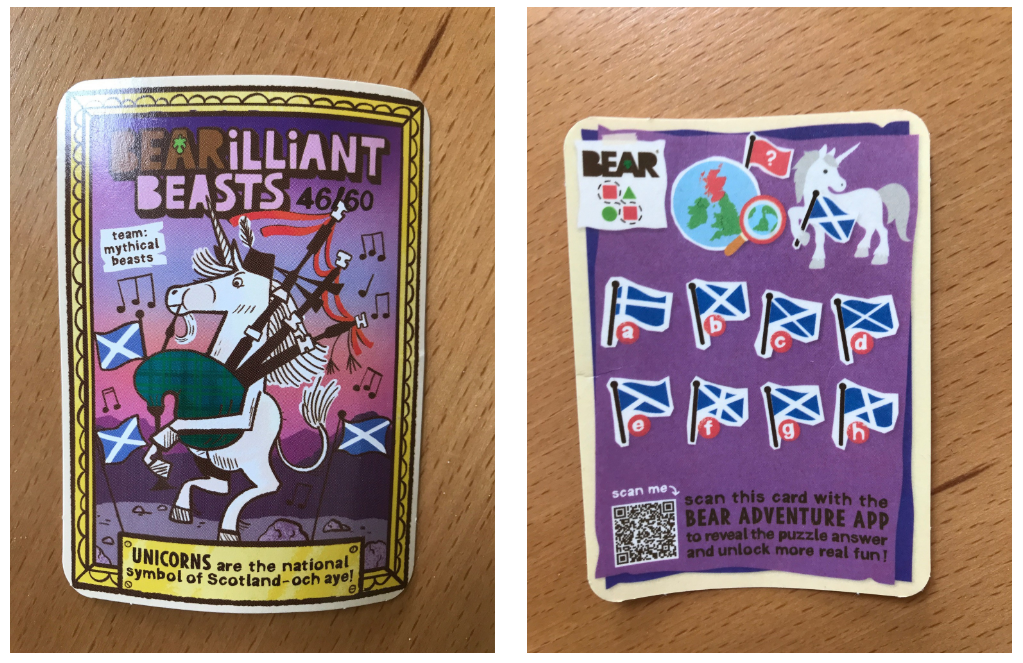
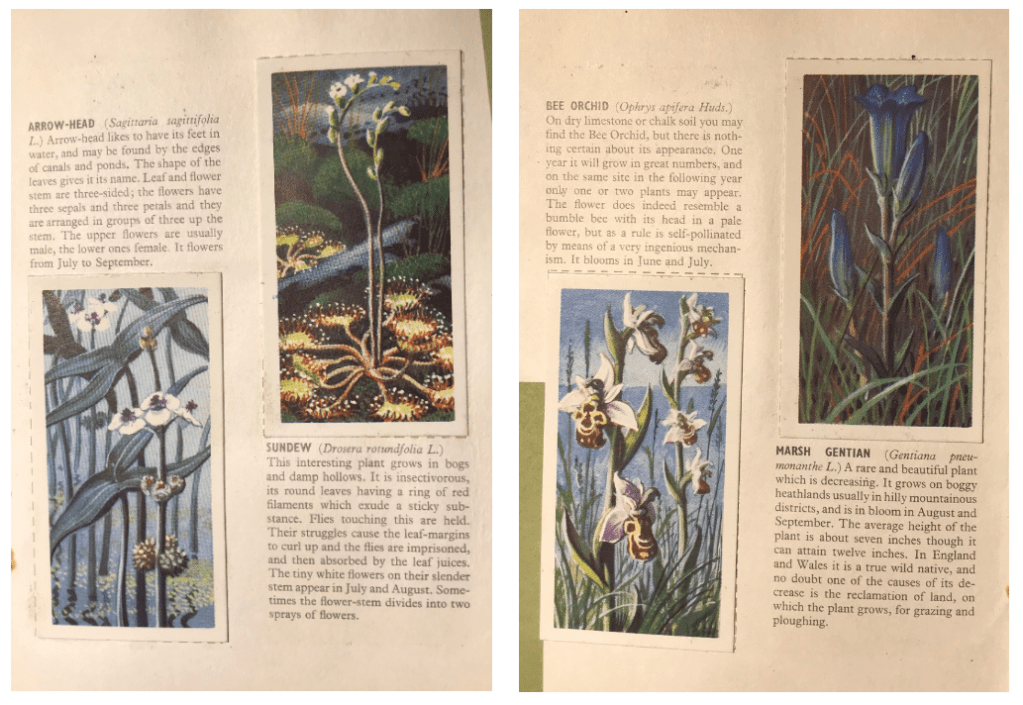
Figure 1: Bear cards (top) bought in 2025. Brooke Bond picture cards (bottom) dating from the 1950s and illustrated by C. F. Tunnicliffe.

When a liberal agenda is allowed to advance unchecked, the drive towards inclusivity eventuates in a climate of mediocrity and selfishness. We end up with absurdities like a monoglot Foreign Office10 and gravestones plastered with safety instructions (Figure 2). In a bid to keep everyone safe, there is a proliferation of rules inside government organizations that demoralizes workers and reduces the efficiency of the system. This makes it easy for Right-wing critics to declare that our institutions are intrinsically flawed, or the liberal mission at fault, when the reality is that the liberal vision has been extrapolated beyond reasonable bounds.

Figure 2: A churchyard in Iffley, Oxford, with laminated safety signs reminding visitors that some of the gravestones may be unstable.

The pursuit of a softer society goes hand-in-hand with technological development. Gray has already explored the conflation of ethical and technological progress in hyper-liberal thought11. The cumulative advance of scientific knowledge is seen by many as proof that Western societies have become more rational. The hyper-liberal is therefore working towards a technological utopia where every problem is solved by a machine, everyone is safe and humans have complete freedom of choice. They do not think seriously about what this dream society would look like, or the types of people who could live in it. There is no reason to suppose that a decent human being can thrive in contemporary society – let alone a woke utopia – filled with screens, endless rules and procedures, near-perfect safety and robbed of the sounds and smells of nature. It is far more likely to cater to fearful, socially dysfunctional, mirthless technocrats, who obsess over their coffee, Formula 1 racing and slapstick comedy. You only have to look at current statistics on the mental health of young people to see how undesirable a techno-utopia would be.

Orwell saw the danger too. In The Road to Wigan Pier, he described how pursuit of progress via unending technological advance could produce a longing for Fascism:

“With their eyes glued to economic facts, [socialists] have proceeded on the assumption that man has no soul, and explicitly or implicitly they have set up the goal of a materialistic Utopia. As a result, Fascism has been able to play upon every instinct that revolts against hedonism and a cheap conception of ‘progress’… It is far worse than useless to write Fascism off as ‘mass sadism’, or some easy phrase of that kind. If you pretend that it is merely an aberration which will presently pass off of its own accord, you are dreaming a dream from which you will awake when someone coshes you with a rubber truncheon. The only possible course is to consider the Fascist case, grasp that there is something to be said for it, and then make it clear to the world that whatever good Fascism contains is also implicit in Socialism.”

And who wouldn’t yearn for some true grit and acceptance of personal responsibility when faced with certain members of our middle class – those who are too anxious to leave the house but think they know how to run the country? Who wouldn’t look back wistfully on a time where things were a little simpler, a little more honest and authoritarian, when politicians had a vision that could be clearly communicated and commonly subscribed to, so that we might set to work on it with gusto? The difficulty lies in convincing people that Fascism is not the answer to our problems with woke and neither is a kind of selfish hedonism. Change should come from the Centre and radiate outwards. Unfortunately – and in accordance with Hegel’s picture of society as a sweeping pendulum – policy is increasingly being dictated by Populists and authoritarians instead.

Implicit vs Explicit Understanding

“… It is the special illusion of literate societies that they are highly aware and individualistic.”

Marshall McLuhan, Understanding Media – p.250.

Perhaps we are being failed by our exaggerated literacy. Most of us now live in societies that only value explicit understanding12. When we cannot write down what a woman is, we are driven into an apoplexy of confusion. In an effort to satisfy everyone, we become blinded by edge cases that do not fit our intuitive, implicit vision of womanhood. For hyper-liberals, it doesn’t matter that Richard Dawkins can supply us with precise scientific definitions of male and female13 because these definitions cannot satisfy everyone in society. The woke conclusion is that the definition of womanhood must be scrapped – that it is meaningless. Iain McGilchrist has this to say on the subject14:

“Once our lives become very largely mediated by self-reflexive language and discourse, as in our postmodern world they are, the explicit stands forward and the implicit retires. Yet almost everything that really matters to us – the beauty of nature, poetry, music, art, narrative, drama, myth, ritual, sex, love, a sense of the sacred – must remain implicit if we are not to destroy their nature.”

The Art of Woke

“… A lot of what we’re doing at the moment doesn’t seem like a culture that is intent on transmitting its values, practices – even artefacts and rituals – into the future. It feels like a culture with a great deal of anxiety about the future… And there’s a problem with the avant-garde… There is no avant-garde anymore. There’s just f*cking Starbucks. And there’s that headline in the Onion: ‘New Starbucks opened in restroom of existing Starbucks’. And that’s the contemporary avant-garde: it’s a Starbucks opened in the toilet of an existing f*cking Starbucks. And you know, a culture without an avant-garde is a culture with no tension; no creative tension between what the norm is – what good, solid family entertainment is – what people are allowed to say and what they aren’t allowed to say. In a way, the avant-garde destroyed itself. It was bowdlerized, it was commercialized and it shot itself in the foot through its own excesses, but nonetheless it’s one of the canaries in the coalmine that tells us we’re in deep doggy doos…”

Will Self. Transcript from “Will Self: A Life in Writing” at the Southbank Centre.

The postmodern obsession with explicit knowledge doesn’t just apply to the transgender debate – we are equally confused if we cannot prove there is a single, “right” way of thinking or cannot write down a general recipe for beauty. Perhaps this reflects the importance of technocrats to the economy and the loss of craft-based skills.

Walking around art galleries today, any criticism on grounds of quality of draughtmanship is seen as an artefact of privilege. Art must be accessible, which people interpret as meaning that any moron is good at it as long as they are making some cheap political point. The politicization of artistic appreciation is well illustrated by the rise and fall of Lizzo. I still recall the exclamations of shock when I said I didn’t like some of her music videos. The implication was that, if you weren’t a fan of her bluntly explicit rap music, or didn’t find this grotesquely overweight and spectacularly unsubtle person beautiful, then you were a chauvinist who could only appreciate conventional pop idols like Shakira or Katy Perry. After allegations of (ironically enough) weight-shaming and sexual harassment were broadcast, however, Lizzo’s celebrity endorsements evaporated and people mysteriously stopped listening to her music. With remarkable celerity, her fans assimilated the new “reality” that she was not a good singer after all. Now, it seems, the champion of beautiful obesity is fast losing weight and approaching the identikit Barbie figure the woke secretly crave. Like the rest of her fans who shout about body positivity and then flock to buy make-up and gym memberships, they do not really believe humans are all equal. It is impossible to think so.

Hyper-liberal tastes have extended their influence like a pall over many aspects of our cultural life, leaving them subdued by a kind of dreary censoriousness. Last year, when a friend played me a video of Zara Larsson’s “Midnight Sun”, I laughed at the incongruity of this woman singing at the summit of a Norwegian mountain wearing a sparkly tennis visor and a slit crop top, her thong riding up suggestively over tracksuit jogging trousers. The laughter was short-lived, however, as I was coldly informed that Zara might just be more “comfortable” in those clothes – even as we watched her push her trousers lower on her hips and caress her bust and her hair. Many hyper-liberals see it as essential to women’s liberation that women play no part in seduction – that women’s bodies be perceived as lifeless and undesirable. They see the male appreciation of female beauty in art as somehow unseemly, yet at the same time they are happy to watch the most obscene species of pornography provided the “action” is not directly harmful. While hyper-liberals sit with eyes ostentatiously averted, the rest of the world continues to employ exactly those techniques of erotic suggestion that they pretend don’t exist in advertisements, films and their own personal lives.

The Tone and the Music


“With much of it, Smiley might in other circumstances have agreed: it was the tone, rather than the music, which alienated him.”

J. LeCarré, Tinker, Tailor, Soldier, Spy – p.388.

“… he would strike with the merciless venom of the fanatic for whom the world holds no gradations – only black and white.”

Mervyn Peake, Gormenghast – p.569 of the Vintage omnibus.

More important even than its philosophical shortcomings, it is the tone of hyper-liberal discourse that is damaging to the liberal project and to public debate in general. The extremity of the woke reaction to discussions of transgender rights led almost immediately to a freezing of debate on a range of issues. In both the public and private spheres, people with moderate views retired from conversations to avoid being misrepresented or misunderstood. Many politicians on the Centre and Left ceased to have personal opinions because they weren’t sure what views were considered permissible. Important writers (e.g. J. K. Rowling, Kate Clanchy), academics (e.g. Kathleen Stock) and political figures were “cancelled” – that is, either they were fired, had awards stripped from them, or were considered so morally compromised that they were written out of history.

In private, conversations with hyper-liberals started to feel like fording a frozen river. It was difficult to know what kind of reaction people were capable of. I myself have observed friends give vent to weird, vitriolic outbursts in the course of normal conversations, where they wish death and ruin on a particular writer or philosopher whose work they have not read and whose arguments they have wholly misunderstood. I have had discussions about trans rights and immigration where my red-faced interlocutor is practically shouting, where veins are pulsing like subcutaneous serpents in their temples, only for them to insist afterwards that the discussion was perfectly amicable – even “fun”. This problem of proportionality, of respectfulness and tone, is rarely observed when talking to people aligned more with the political Right. Though I may object to many of their ideas, Right-leaning people tend to lack the shivering neurosis of some hyper-liberals and the terrifying conviction that their opponents are evil. They do not start screaming that you are threatening someone if you disagree and the result is generally a lively, enjoyable discussion that both parties can learn from.

The tone you adopt in a conversation is the outward expression of your frame of mind. If you cannot speak to someone who disagrees with you without the conversation degenerating into a bitter argument then it is a poor advertisement of character. Respectfulness and politeness are particularly important in public discourse, where the goal is to educate and inform. A degree of trust is required from both parties – a willingness to believe that there is some truth in each other’s perspective. The difficulty is that hyper-liberals think that they are right by default.

There are few acts more pungent of dogmatism than telling someone they are not allowed to not take sides; that if you are not with the hyper-liberals, you are against them and if you are not sure whether you think a “trans” person should be formally recognised as a member of the opposite sex then you are transphobic. To say that if you do not believe them then you want to kill them is a form of hostage-taking. The same tactics were used in the Cold War with Soviet Communism and McCarthyism – and it is happening again today with woke.

The importance of tone, which is eloquent of character and one’s willingness to enter honestly and enquiringly into discussion, is addressed repeatedly in the novels of John LeCarré. LeCarré sketches the British liberal and Soviet communist approach to espionage from different angles. His heroes are flawed but admirable, combining a “feeling heart” with a “corrosive eye”. They are meant as a vindication of the age-old British trust in “character over intellect”15 – the belief that there are qualities more important in a leader than the horse-power their brain can convoke. There is knowledge buried in diverse places – and even first-rate minds can be betrayed by solipsism, through ignorance of the experience of others.

This is not to say that LeCarré presents the liberal side as uniformly good and the communist uniformly bad – his novels are shot through with criticisms of the liberal side and the ethical difficulties the spies are forced into – but he certainly paints the liberal characters as more conflicted than the communists. They are more self-aware, less fanatical and have a greater potential for compassion (even if, often, their methods are just as devious as those of their opponents). In the words of George Smiley – who is a kind of banner-bearer for the liberal cause – the British service should be16:

“…inhuman in defence of our humanity, harsh in defence of compassion. To be single-minded in defence of our disparity.”

LeCarré – through Smiley – is acknowledging the contradiction; in order to defend our liberal values, sometimes extreme methods must be used that could not otherwise be tolerated, from which one’s conscience recoils. This can be contrasted with the attitude of his Communist counterparts, who see their ethical principles as consistent, who have a fanatical loyalty to their regime and for whom ends always justify the means. For them, their ideal conception of a communist society has grown so large that it occludes the reality of the human condition. What they see as strength is in reality a fatal weakness17:

“All our work – yours and mine – is rooted in the theory that the whole is more important than the individual. That is why a Communist sees his secret service as a natural extension of his arm, and that is why in your own country intelligence is shrouded in a sort of pudeur anglaise.”

In the end, both sides in the Cold War were willing to do appalling things in order to get ahead in the game of intelligence, but the impression you have from LeCarré’s writing – whether or not it is true I cannot say – is that the British “owls” retained a degree of scepticism, perhaps even uncertainty, throughout. I consider that significant.

Orwell also felt that the state of mind in which you approach a necessary (though perhaps distasteful) thing is important. He writes in The Road to Wigan Pier18:

“The sensitive person’s hostility towards the machine is in some sense unrealistic, because of the obvious fact that the machine has come to stay. But as an attitude of mind there is a great deal to be said for it. The machine has got to be accepted, but it is probably better to accept it as one accepts a drug – that is, grudgingly and suspiciously. Like a drug, the machine is useful, dangerous and habit-forming. The oftener one surrenders to it the tighter its grip becomes.”

It is a persistent theme in the fiction of Orwell and LeCarré that humans are imperfect and our politics should reflect this. It is essential to understand that it is not defeatist to accept that humans are limited and that their needs are often in conflict with one another. There is no other way for a social, biological animal to be. It is for this reason that we embrace a degree of compromise, a degree of hypocrisy. Policy-making is a constant tension between idealism and pragmatism, between needs and desires, viewed murkily through an aberrated lens. When the context changes, so too – sometimes – does the ethical course of action. No moral system of ethics is consistent. A consistent ideology would entail the annihilation of humanity. The British parliament, with two main opposing parties, is one way to balance the interests of different social groups. But hyper-liberals do not see it this way. They are looking for an immortal victory.

Choosing the Turd

Whether we are discussing the selection of products in a supermarket or the range of programmes on Netflix, giving the people “what they want” is nowadays seen as vitally important. The value of increasing “representation” is not clear-cut, however. Too often, this kind of democratic appeal is used to justify the persistent appearance of the lowest grade of product (cultural or comestible) in the marketplace.

If a third of the evening news is devoted to football in a time of international political crisis, or if ten seconds is devoted to entomology, then the editor must answer for their decision. And the decision should not always be made entirely on the basis of what the editor expects people will like. That is not the point of news presented as a compilation of current affairs (at least, that is the chief advantage of a publicly-funded national news service like the BBC – private news services must ally themselves more closely to the tastes of their clientèle). Nor is it possible to say that people truly want what they claim to want. You cannot want the unknown or unexpected. And do I truly want the thing I cannot help but desire? Would the public really prefer the gaudy trinket, the salacious tidbit, the sugared sweetmeat over a quality product? Whichever answer you choose, it is essential to recognise that your choice is never value-free. And the suggestion -usually promulgated by business owners – that supermarkets merely follow the tastes of the consumer is both wrong and disingenuous. Desire can be curated. It is not so difficult to convince people to buy the products on offer. New products are often produced in consultation with supermarket brands that are expert in consumer manipulation. The hyper-liberals think that when they choose who they are, or what they want to buy (Fig. 3), there is a kind of purity in their decision – a loyalty to their true and immortal self that justifies their choice. And they believe that this freedom is a right instead of a privilege.
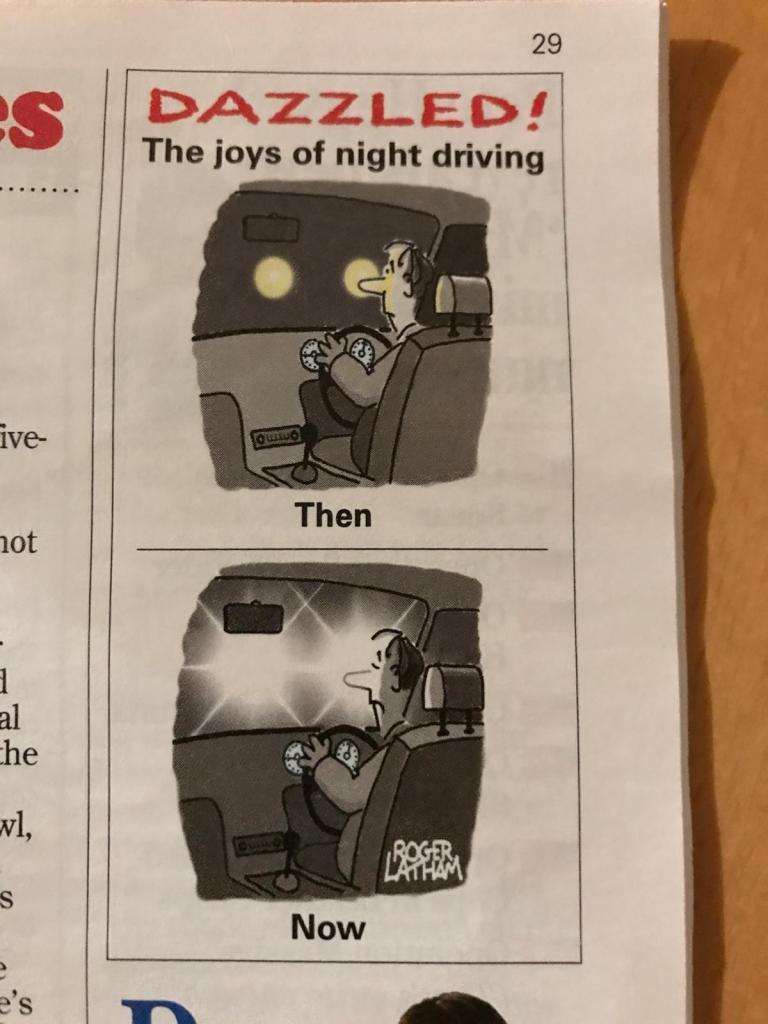
Fig 3: Illustration by Roger Latham for Private Eye, satirising the push towards brighter and brighter lights on cars and bikes.

The question of personal choice is particularly important in the education of children. Before hyper-liberalism, children were generally recognized to be only partially formed as personalities. They were impressionable creatures for whom we want the best and who must therefore be given lessons in reality, who must undergo trials like exams and competitions to strengthen character because we know that total insulation from stress and danger is damaging if they are to grow to live wholesomely and happily in the world. The current obsession with “choice” feels like a maniac response to Peter Weir’s Dead Poets Society. Horrified by the picture of the pitiless father who insists his son study medicine instead of art, hyper-liberals have decided that children should be allowed to choose what they learn, what they eat, how they eat, what sex they are – and that their conviction is the fruit of some deep, immiscible personal identity.

Should we play to the lowest impulses of the lowest common denominator to be “inclusive”, or do you provide children with content that pushes them, that feels excitingly adult? Looking at Fig. 1, I would suggest the answer is written plainly in the cards. When teaching literature at school, is it necessary for every (or indeed any) child to “understand” the entire text? Philip Pullman would say no. He would say that it is enough to feel the music of a poem and to understand it in part. A human is not a static quantity with an imperishable and inviolate soul – our personalities are constructed non-linearly as our bodies interact with their surroundings. We pick up lessons and fugitive images that recur in unlooked-for ways – both good and bad. Sometimes the value is only apparent later. In their effort to eliminate suffering for all children, hyper-liberals endanger the efficacy of the educational enterprise.

Free the nipple, free the soul

« Il faudra bientôt construire des cloîtres rigoureusement isolés, où ni les ondes ni les feuilles n’entreront, dans lesquels l’ignorance de toute politique sera préservée et cultivée. On y méprisera la vitesse, le nombre, les effets de masse, de surprise, de contraste et de répétitions, de nouveauté et de crédulité. C’est là qu’à certains jours, on ira, à travers les grilles, considérer quelques spécimens d’hommes libres. »

Paul Valéry, Fluctuations sur la liberté, 1938.

The imaginary human beings of woke thought are free. They feel they should be free to realise their desires, so long as they do not directly harm others. They feel that people should be free to make decisions about how to identify, how to behave, how to dress, how to think, because they can – because they possess, on some deep level, free will. The corollary is that people who do not behave as they should, or who do not believe the woke orthodoxy, are intrinsically evil. Orwell observed the same attitude in the Socialism of the 1930s:

“Faced by the fact that intelligent people are so often on the other side, the Socialist is apt to set it down to corrupt motives (conscious or unconscious)…”
Chap. 12.

Here, we have arrived at a vision of humanity that feels very Christian and a picture of the individual much like a soul. Indeed, this is precisely Gray’s conclusion in New Leviathans: that the woke movement has reinvented the Christian soul without the theological buttressing. They believe human identity is determined from the earliest stages of development, so children can be given tremendous freedom to make their own choices. Perhaps they see children as privy to a self-knowledge which adults gradually forget?

When postmodern society rejected religious explanations of how the world worked and came to be, certain ethical ideas, long associated with a religious outlook, also declined in popularity. We discarded the idea that humans should be modest and not challenge the gods, or that they would always be limited by the boundaries of the world and divine strictures, replacing them with an equally unscientific and hubristic humanist perspective, grounded in the idea that humans can be made “rational”, that we will transcend the boundaries of the Earth and that every problem has a technical solution because humans can do anything. It is from this new, human-centric position that certain members of the middle class feel able to declare that everyone is free and entitled to a VW campervan. Science repeatedly defies our expectations, but that doesn’t mean it can make subjective problems objective, or turn humans into gods.

Gray observes that the “freer” our liberal society has become, the more it must be “monitored and controlled”. This is because a woke Utopia is not just free, it is also safe, non-discriminatory and equal. Hyper-liberals do not see humans as animals except in the narrowest sense of us having evolved from primates. In their view, humans are perfectible and ethical problems have unique solutions. They do not see that total safety implies total control and total misery. For every additional freedom, a new rule must be made to enforce it. Kurt Vonnegut has already caricatured an equal society of this type in his short story Harrison Bergeron, where the “Handicapper General” dispenses handicaps to ensure that clever people cannot think too clearly, strong people cannot take advantage of their strength and beautiful people are made plain.

Politics is a closed surface. Go too far to the Left you end up on the Right. If you forget that humans are animals – inescapably limited, limited by definition – then you produce tyrannical systems of thought, like Soviet Communism and hyper-liberalism. Broadminded leadership is needed to maintain an implicit understanding of context, of human psychological complexity, if we are to prevent inhuman policies from being passed that presuppose infinite capacities of human organisation or flexibility of thought. The goals of equality and prosperity for all must be approached but never realised.

Reform – not Reform

Each age has its own political challenges and ours, it seems, is woke. If we are to make any further progress as a nation, we need to roll back the tyranny of the neurotic and return to a measured form of public discourse – where a disproportionate reaction is recognised as such. Various books and newspaper articles have recently been published asserting that woke is “dead”. And I grant you, in the eight months or so since I started this essay, there has been a selective thawing of the political landscape19. But the processes that drive political polarization have not yet disappeared. I notice the same hyper-liberal ideas cropping up daily in conversation – the obsession with personal identity, or the insistence that everyone submit to false choices between apparent opposites like being inclusive and exclusive, or strict and loving20. We must be wary of nihilism, free market consumerism and social isolation. Above all, on both the Left and the Right, we must avoid a politics of selfishness. When the self is sovereign over society, fear and self-preservation triumph over transcendent goals. We see it when people use poor government services as an excuse to avoid taxation; or when they claim that life ought not be difficult and people do not need to earn the benefits they expect from society.

When ideas like these become dominant across the political landscape, it suggests the liberal narrative has overreached itself. But this is not a calamitous, final repudiation of liberal ideas. Nor does it prove that they are unusually flawed. History is a record of the rise and decay of human institutions. Already in the last century, liberal institutions have cycled through periods of waxing and waning influence. If our conception of a good, liberal philosophy has stagnated and started to rot, the infected areas should be cut off, preserving those aspects of the original vision that are still beneficial in the context of the present age. A new movement can then be painstakingly rebuilt on the excarnated bones of the old. Jared Diamond has shown how, when countries are faced with existential crises, this type of selective rebirth is possible – in Finland, Germany and Japan, for example21. And Mark Carney has described how political pragmatism will be crucial for countries like Canada and the UK as they try to retain influence in a world dominated by superpowers that no longer pay lip service to common laws22.

Those of us who bemoan the current state of the political centre would do well to think about how this type of long-term strategy might be applied in our own approach to politics. I think it is less a question of being “smarter” (which many on the left associate with a lack of integrity) than of not being stupid. The problem is clear from the Left’s reaction to Keir Starmer, which has been consistently negative from the outset of his premiership. Just weeks after Parliament’s summer recess in 2024, left-liberal friends were complaining that Starmer hadn’t achieved enough, as though they expected him to magic up tangible change in one month, after fifteen years of austerity and Conservative rule. Starmer has since made progress on diverse fronts – with increased protection for renters, some improvements to rail services23, the economy, international relations and the environment24 – but his approval amongst Labour voters has remained low. There are various legitimate criticisms one could make against Starmer – his lack of conviction, his spineless initial stance during the transgender debates, his policies on the right to protest – and clearly there is a problem with Starmer’s own style of communication, which makes him appear curiously thin and platitudinous. But the real reputational damage amongst the middle class hasn’t come from what Starmer has done – it came from what he didn’t say, or wasn’t deemed to say quickly enough, as part of Labour’s response to the war in Palestine (which was essentially cautious, following persistent allegations of anti-semitism under Corbyn). The problem is not that hyper-liberals disagree with Starmer’s policies or rhetoric, it is that they allow a minor action on a single issue to colour their entire perception of him as a person. They do not suppose that Prime Ministers may have important (and necessarily obscure) reasons for acting in the ways that they do. This sort of “cancellation” is the ultimate repudiation of someone’s record, a kind of monstrously inaccurate extrapolation. It smacks of the same dogmatic pedantry seen in the wars of religion (which is what gave birth to liberalism in the first place).

I think one of the reasons people come up with absurd caricatures of politicians is they have no feel for who they are as people, or what their basic ethical assumptions are. If you have a realistic understanding of how politicians think, it is harder to be convinced by their portrayal in the media as fairytale villains. A podcast or radio programme might be used to address this. There could be interviews on basic moral questions, like in Radio 4’s Moral Maze, and there could be provision for politicians to talk more expansively about their dreams, helping us to separate out those with ideas – with vision – from those who do not.

When you have succeeded in developing a centrist political movement, the next most important requirement, going forward, is to find someone with a dream of Britain that is inspiring and easy to communicate. This is not the same as finding someone who can voice an opinion. Rather, one can view it as the political analogue of Benedict Macdonald’s vision for a wilder Britain. In his book Rebirding, Macdonald argues that restoring our wilderness requires a drastic, large-scale overhaul of our countryside – with less emphasis placed on micro-managed reserves where the (probably temporary) survival of certain species may hinge on one or two ditches or a scrape of sandy soil. Part of this argument’s appeal is its ambition – it would require thousands of square kilometres of agricultural land to revert to wetland habitat. A rare character is needed to make this prospect inspiring rather than frightening, someone who can conjure the ghosts of our most beautiful lost species – the nightingales, wrynecks, Dalmatian pelicans – and hold them hard in their mind’s eye for everyone to see.

There is, however, an obstacle to achieving this level of vision and singularity of purpose in large organisations. Modern charities, large companies and government institutions all suffer from inertia brought about by Byzantine layers of organisation, short-term financial pressures, excessive internal regulation, a narrowing of job roles and a loss of individual responsibility, which is demoralising and increases friction between the centres of decision and operation25. On top of this, it has become fashionable to freight official reports with abstract and technical jargon26, making it harder to recognize results and easier for ideological change to be dressed up as tangible improvement. Rejecting this meaningless technical language would be a first step towards greater efficiency and clarity of focus. The second step is to find someone who really embodies change – who can pull philosophy into the world.

As always in politics, a balance must be struck between idealism and pragmatism. -What balance? Who knows? But the solution is unlikely to be the headless, incoherent, “all-inclusive” revolution envisaged by Corbyn and Sultana. Better to bring together a cadre of talented, charismatic people inside one of the existing political parties; a group who can establish a simple narrative of reviving a country that is in decline, with serious priorities for the country beyond trans rights or peace in Gaza.

It is crucial, now, that we rapidly transform the economy into something that is more tightly controlled and ambitiously sustainable. And the argument for this must draw on our strengths – our shared identity as a nation. Theresa May’s 2017 manifesto seemed to strike the right tone27:

“We do not believe in untrammelled free markets. We reject the cult of selfish individualism. We abhor social division, injustice, unfairness and inequality. We see rigid dogma and ideology not just as needless but dangerous. True conservatism means a commitment to country and community; a belief not just in society but in the good that government can do; a respect for the local and national institutions that bind us together… We respect the fact that society is a contract between the generations: a partnership between those who are living, those who have lived before us, and those who are yet to be born.”

It is a handsome vision to be sure, but statements of political philosophy should be anchored to basic, unambiguous metrics of success – the prime measurables of living standards like public health, transport, education, the wild places. When you have a clear hold on the ground-level change you want to see, the bigger goals will follow, and a new picture will form as surely as a rain of iron filings will freeze along a magnetic field.

  •  
  1. J. Bindel, The Green Party’s war on women, Unherd (2025). URL: https://unherd.com/2025/10/the-green-partys-war-on-women/?tl_inbound=1&tl_groups[0]=18743&tl_period_type=3&utm_source=UnHerd+Today&utm_campaign=c9ea590811-EMAIL_CAMPAIGN_2025_10_09_09_04&utm_medium=email&utm_term=0_79fd0df946-c9ea590811-73216643 ↩︎
  2. These are not the opinions of any one individual. They are a collection of ideas presented to me by friends, colleagues and acquaintances in diverse contexts over the past six years or so. ↩︎
  3. These rights may include: trans people should be able to use the same toilets as members of their adopted sex; that other people should advertise their own preferred personal pronouns in meetings or in emails so that trans people feel more comfortable; that trans people should be able to receive awards and enter competitions as though they are a member of their adopted sex; that gender reassignment surgery should be available on the NHS, etc. ↩︎
  4. J. LeCarré, The Spy Who Came in from the Cold. ↩︎
  5. See p. 311 of reference 22 by J. Diamond. ↩︎
  6. R. Horowitch, Accommodation Nation, The Atlantic (2025). ↩︎
  7. There are various programs one could cite here, from social reform under Soviet communism to foreign interference in Afghanistan (see, for example, Adam Curtis’ documentary Bitter Lake). ↩︎
  8. See articles by Hadley Freeman and Kate Clanchy. ↩︎
  9. See Richard Dawkins interviewed by Piers Morgan or Grayson Perry interviewed by Kirsty Young in Young Again. ↩︎
  10. I. Proud, Britain’s Diplomats are Monolingual, Unherd (2025). URL: https://unherd.com/2025/05/britains-diplomats-are-monolingual/ ↩︎
  11. J. Gray, Straw Dogs, 2003 edition by Granta Books. ↩︎
  12. Of course, this applies differently to different countries. France, for example, has greater respect for its traditional craft techniques and practices than the UK. ↩︎
  13. R. Dawkins, Why Men and Women are Different, Unherd (2025). URL: https://unherd.com/2025/08/why-men-are-different-from-women/ ↩︎
  14. Iain McGilchrist has spoken and written extensively about the differences between implicit and explicit understanding. See McGilchrist’s address to Darwin college, Cambridge, entitled A Revolution in Thought, (14:30 onwards). URL: https://www.youtube.com/watch?v=2JfbIJe31Rw&list=LL&index=83&t=1196s ↩︎
  15. M. McLuhan, Understanding Media, first published in 1964. ↩︎
  16. J. LeCarré, The Honourable Schoolboy. ↩︎
  17. J. LeCarré, The Spy Who Came in from the Cold – p. 113. ↩︎
  18. G. Orwell, The Road to Wigan Pier – p. 196. ↩︎
  19. Some examples include the rehabilitation of “cancelled” author Kate Clanchy, or the 2025 Supreme Court rulings on the definition of “sex” in the Equality Act of 2010. ↩︎
  20. Ed Vainker, quoted by Rory Stewart on p.304 of ref. 26. ↩︎
  21. J. Diamond, Upheaval: How Nation’s Cope with Crisis and Change – Penguin 2020 edition. ↩︎
  22. See Mark Carney’s speech at the 2026 Davos World Economic Forum. ↩︎
  23. Further information on the Renter’s Rights Act 2025 and Great British Rail can be found here: https://whathaskeirdone.co.uk/results. ↩︎
  24. For information about Great British Energy and the Great British Energy Act 2025, see URL: https://en.wikipedia.org/wiki/Great_British_Energy_Act_2025 ↩︎
  25. See talks/articles by Dominic Cummings and Iain McGilchrist for more on bureaucratic inefficiencies. ↩︎
  26. B. Macdonald, Rebirding – 2020 edition by Pelagic Publishing and R. Stewart, Politics on the Edge – Vintage 2024. ↩︎
  27. Forward, Together – Conservative and Unionist Party Manifesto, 2017. ↩︎

Vaclav Havel’s Need for Transcendence in the Postmodern World

In 1994, shortly after becoming President of the Czech Republic, Vaclav Havel travelled to the USA and delivered an address in Philadelphia called “The Need for Transcendence in the Postmodern World”. The USSR had recently collapsed and a new form of capitalism was spreading its influence over the world, connecting disparate cultures via fractal conduits of trade and migration. Havel worried that without some new narrative to paper over their differences, this abrupt connection of cultures would lead to conflict. Wars were already sparking in the Middle East and Europe and international diplomacy was difficult. Cooperation required governments to look past their own interests in favour of a more general conception of progress. People needed a unifying ideal to cleave to, which would encourage them to move with one purpose against international problems. It had to be new, because the 20th Century was an age of emancipation where people had begun to recognize the richness of different perspectives; there were protections for indigenous cultures and no single ideology of the time was strong enough to overpower all the others. Organized religion was also declining in the West, where science had replaced metaphysical explanations of natural phenomena and damaged the credibility of the religious enterprise. Havel therefore looked for inspiration in two ideas drawn directly from modern science. He called them “transcendent” in the hope they might provide us with a sense of rootedness in the cosmos and encourage us to see things from a superhuman vantage. Contemplating them would be like turning over a precious jewel in your hand, as facets become alternately reflective and transparent and expose, by turns, the dark interior of the mineral or the refulgent world around it.

The Ideas

“…Because it’s not enough to just live. You have to have something to live for. Let it be Earth.”

Admiral William “Bill” Adama – Battlestar Galactica.

The first of Havel’s transcendent ideas is the Anthropic principle, which was developed originally to help explain a puzzle in cosmology. By the mid-twentieth century, astronomers had discovered that space was accelerating – the universe did not appear to be in a steady state – and they knew that the heavy elements essential to life had been created gradually in stars through a process of nuclear fusion. They also knew that stars have finite lives – that they burn up and out, cooling over time – and their propensity to harbour life in rocky planetary systems diminishes as the universe ages. It follows that carbon-based life forms like humans could not evolve if the universe were significantly older or younger than its present age. Moreover, it suggests that we find ourselves looking out on a cosmos at an auspicious moment1, a kind of island of habitability where conditions are conducive to life.

The Anthropic principle – or the observation selection argument – says it is natural the universe should be the age it is, since if the universe were significantly older or younger there would be no sentient life around to notice. The same argument can be used to explain why the universe’s physical laws appear to be fine-tuned for life. The various forces and species of matter are related in a very particular way. Were the relative strengths of the fundamental forces slightly different, not only would life be prevented from evolving, but there would be myriad other effects: heavy elements would not be able to fuse in the furnaces of the stars, the structure of atoms would dissolve and the universe might expand too fast or collapse too early to allow life to develop.

In summary, the Anthropic principle says that it is necessary that life forms should observe a universe which operates in a state and at a time propitious for life. Havel felt this tautology might accord humanity a special place in the universe. He observed in his Philadelphia address that:

“…from the countless possible courses of its evolution the universe took the only one that enabled life to emerge.”

In other words: since we are here, privileged to be able to look out at an otherwise sterile cosmos, one might conclude that the purpose of the universe was to produce life on Earth – perhaps, even, to produce humankind2.

It is an arresting thought and like many others I find Havel’s formulation of the Anthropic principle attractive. But there are also some important philosophical objections. By suggesting that the universe was meant to produce human life, Havel follows in a long line of philosophers who try to lend humans a noble position in the hierarchy of things. Strictly speaking, however, one might follow the same line of argument and infer that the purpose of the universe was to create rocks – or puddles. In The Salmon of Doubt, Douglas Adams joked that a puddle might look up at the clouds which disburse rain, then at the numerous puddle-shaped depressions in the ground and equally conclude that the benevolent purpose of the universe was to produce puddles.

I can think of a further, more fundamental objection, which is that it makes no sense to define the purpose of everything there is. Teleology makes no sense with respect to everything – only between two or more things. That is why humans invent Gods to lend meaning to everything they can see – but the logic is faulty, for in positing a God, we have ignored the original problem, which was to explain everything instead of just a part of everything. Asking what is the purpose of everything is therefore meaningless. If modern scientific theories are correct, and humans developed naturally out of the interstellar medium, then human purpose can only be understood in terms of the rules that brought them into being and which govern their development. Purpose only makes sense without a maker if you have a mechanism like evolution, where the rules of the biological system determine how the system will play out.

Havel’s second transcendent idea is the Gaia hypothesis. Introduced in the 1970s by James Lovelock and Lynn Margulis, Gaia theory says that the Earth is maintained in a state favourable to life by a series of negative feedback loops. The whole of the Earth – atmosphere, lithosphere and biosphere – can be viewed as a single, self-regulating system that holds the temperature and chemical composition of the Earth’s surface within limited bounds. The idea was prompted by several observations3: for example, that the biosphere is able to withstand tremendous shocks from volcanic eruption or asteroid impact, that the temperature of the Earth’s surface has been largely constant for billions of years despite increasing solar luminosity and that the atmosphere is maintained within a state of high thermodynamic “disequilibrium”4 (i.e. reactive gases like oxygen and methane are constantly replenished5).

Lovelock illustrated his idea with the Daisyworld model, where a planet is inhabited by two different species of daisy – one white and the other black. Daisyworld is experiencing a period of global warming, caused by the brightening of its parent sun. The white daisies reflect sunlight, cooling the planet, while the black ones absorb sunlight and heat the planet up. Their growth rates are assumed to depend solely on temperature and neither daisy can survive in excessive heat or cold, so the populations reorganize themselves, as the sunlight intensifies, so that the temperature remains comfortable. The daisies are therefore able to stabilize their environment without conscious intention. Lovelock proposed that similar (though much more complex) feedback mechanisms of biology and chemistry have been active on the Earth throughout its history. If there is a significant perturbation in living conditions, then the balance of biological populations will adjust to compensate. Havel put it like this:

“[Gaia] theory brings together proof that the dense network of mutual interactions between the organic and inorganic portions of the earth’s surface form a single system, a kind of mega-organism, a living planet – Gaia – named after an ancient goddess who is recognizable as an archetype of the Earth Mother in perhaps all religions. According to the Gaia Hypothesis, we are parts of a greater whole. If we endanger her, she will dispense with us in the interest of a higher value – that is, life itself.”

The Point

In his capacity as playwright and politician, Havel was trying to generate a narrative anchor that would inspire people to work for the general good of the planet. In a way, his argument is a humanist response to nihilism. Like Nietzsche, he is striving to impose meaning on a meaningless world. This may sound absurd (it is absurd) but there is nothing strange or laughable about it. Humans are compelled to weave their own struggles into stories so that they can make decisions about the future. We can understand this with an analogy:

Imagine you have designed a species of biological robot whose sole purpose is to pass on its genetic programming to future generations. The robot lives as part of a group in order to increase its chances of survival and procreation and therefore needs to consider its own needs and to weigh them against those of other individuals in the group. Since there is no absolute purpose to their lives beyond the continuation of their genes – and because you cannot hard-code a response to every imaginable crisis – you program the robots to make decisions based on the problems they can see around them. They build these problems into abstract narratives, which place the robots in the context of the problem and shut out all the extraneous noise of the universe. In this way, the tremendous complexity of a real-life problem is reduced to a simple, idealized case. The process is similar to building theoretical models in the sciences.

It seems to me that humans have developed like this and we use narratives like this. When faced with global problems, we invent stories which involve all of humanity in a struggle against those problems. Difficulties arise when other humans (most of us who do not work in international relations) have their own troubles that resonate louder than the global narrative. These might be because day-to-day survival is more important, or simply because an individual cannot picture themselves in a global context and chooses to pursue personal goals instead. Looking at recent progress in tackling climate change, it is clear that we cannot easily make a global narrative more urgent in the mind than a narrative of nationhood, race, or personal gain6. Inventing an inter-planetary or inter-species war would probably be the most expedient way to overcome our differences – something akin to the plot of the Battlestar Galactica television series, Watchmen or The Three Body Problem. The tragedy – if one can call it that – of our isolation is that the only enemies we can find, now, are other humans.

Notes and Further Reading

  1. In this context, “moment” refers to a span of several billion years…! ↩︎
  2. Although the non-avian dinosaurs – whose own evolutionary aspirations were so rudely curtailed at the end of the Cretaceous period – might have something to say about Havel’s anthropocentric philosophy. ↩︎
  3. https://www.sciencedirect.com/topics/earth-and-planetary-sciences/gaia-hypothesis ↩︎
  4. https://www.nature.com/articles/d41586-019-01969-y ↩︎
  5. This can be contrasted with the atmosphere of a dead planet like Mars, which is static and composed almost exclusively of inert carbon dioxide. ↩︎
  6. J. Diamond, Upheaval: How Nations Cope with Crisis and Change, Penguin Books, 2020. ↩︎

Prisoners of Progress

From Modern Elfland by G. K. Chesterton

+++

Human technological and military advances are locked in a perpetual striving for improvement that can never end except by mutual agreement. It comes down to a problem of trust: can you rely on your neighbour not to continue their research and either outcompete you economically or threaten you with physical attack? Military expansion is not, therefore, just caused by a few belligerent generals. It responds to a strategic problem that – in the absence of trust between parties – forces countries into a permanent state of escalation.

This question of trust appears in a whole range of leadership scenarios: in the nuclear arms race of the Cold War, in the tension between the state and the market and the coordination of an international response to climate change. All of these situations can be recast in terms of the “prisoner’s dilemma” – a thought experiment in game theory – where two rational people can cooperate for mutual gain or betray their partner for an individual reward. The cycle of hostility can only be broken through cooperation or total domination of foreign parties.

Unfortunately for the human race, many of the major threats to its existence hinge, now, on its ability to coordinate internationally. This is difficult because sympathy and understanding must bridge cultural and historical divides. Worse: technology has now reached a point where the consequences of one nation’s actions have world-spanning consequences. As Asimov observed in the twentieth century, the destruction of the Amazon rainforest by Brazil would destabilize the climate of the entire Earth.

+++

“Invisible even in a telescope magnifying sixty times, even in purest summer sky, they drifted idly above the glittering Channel water. They had no song. Their calls were harsh and ugly. But their soaring was like an endless silent singing. What else had they to do? They were sea falcons now. There was nothing to keep them to the land. Foul poison burned within them like a burrowing fuse. Their life was lonely death, and would not be renewed. All they could do was take their glory to the sky. They were the last of their race.”

J. A. Baker, Peregrine [1]

All technology relies on a localized imbalance that can be leveraged for material advantage. Consider monocultures, where large areas of land are given over to the intensive cultivation of a particular crop. In the interests of efficiency and short-term yield, the farmer replaces a mix of many species with just a single variety. This technique works, provided natural systems of renewal can continue to function outside of the area under management. Once the disturbance becomes more general, however, the existing biological system will start to break down. Success relies on the technology remaining a localised – rather than a global – disturbance. If the imbalance becomes general – if the disturbance spans the entire system – then a crisis is necessarily triggered.

The world has always been finite, but only now that human industry has surpassed a certain critical size is this reality noticeable. Like Uroborus of the Greeks or the Norse Miogarosormr [2], our appetites have grown so large that they compass the world. The biosphere is engaged in new kind of auto-ingestion, where we consume processed foods and supplements and bi-directional digital media is integrated more and more invasively into our bodies and minds. But there are other products of industry which find their way inside us accidentally: detergents, pesticides and agricultural run-off seep quietly into our rivers and seas and the kilter of gases in the atmosphere is warped by the products of combustion – not enough to affect our ability to breathe, but sufficient to alter the climate and the growth rate of trees.

+++

“We are survival machines – robot vehicles blindly programmed to preserve the selfish molecules known as genes.”

Richard Dawkins, The Selfish Gene.

Assuming that it did not just appear one day fully-formed, as an emergent property of consciousness, morality must have developed by some statistical rule of survival. Morality would therefore have grown naturally out of a process of Darwinian selection, like the rest of our bodies; and since they have an important influence on how we behave towards other animals, moral principles must mirror the mathematics of game theory, which is the mathematics of interpersonal relationships.

In The Evolution of Cooperation, Robert Axelrod used computer algorithms to study how morality might be naturally selected. The algorithms competed one-on-one in successive bouts of a game called the prisoner’s dilemma. In the game, two players are given the choice of cooperating with one another or defecting. The players are isolated, so their decision can’t be affected by knowledge of the other’s choice. If both players cooperate then they will receive a reward and if both defect they will be punished, but if one defects and the other cooperates then the defector will receive a more significant reward than if both parties had cooperated. So there is a temptation to defect if your opponent cooperates, but a punishment is incurred if both parties defect. Axelrod’s rules of quantitative reward and punishment can be seen in the “pay-off matrix” below [3]:

Each of Axelrod’s algorithms were programmed with different moral principles – different relationship strategies – which determined to what extent they would cooperate or defect. Two algorithms would play the game a set number of times and their cumulative scores would be recorded before a winner was declared. Algorithms would also be able to make decisions based on the outcome of previous encounters. For example, they might be programmed to defect if their opponent defected in the previous round. Remarkably, Axelrod found that the algorithms which were most successful in large tournaments (where each algorithm would play against many other algorithms over a long period of time) tended to possess the following four characteristics [4]:

(i) They would be “nice”, which means they would tend to cooperate and never be the first to defect.
(ii) They would be reciprocal, or retaliatory. They would return defection for defection, or cooperation for cooperation.
(iii) They would not be “envious”. They would try to maximize their own score, rather than try to keep their score higher than their competitor’s.
(iv) They would not be too obscure or scheming in their approach. They would have clarity of strategy to encourage cooperation.

In effect, he found that “altruistic” strategies were more successful than “greedy” strategies.

Axelrod’s experiments were simplified zero-sum scenarios1, but we already have evidence that cooperation is a more effective social survival strategy than selfishness, because humans are cooperative and other social animals are too. Chimps, gorillas, whales and various birds exhibit emotional behaviours that closely mirror our own. They appear to be capable of experiencing emotions like grief and love; they have their own social hierarchy and sometimes can even recognize the social hierarchies of humans. What we are finding, then, is that our emotions and even our morality grow naturally out of physical and mathematical laws rather than automatically from the spark of human consciousness itself – they develop in animals with strong social relationships because survival in groups promotes a certain type of behaviour.

+++

Technological progress is much easier to define than progress for humanity as a whole. Where technological innovations enhance the speed, scope, power or efficiency of a machine, their benefit to humanity can only be assessed subjectively, according to context. Often it is difficult to say whether a given technology represents a genuine step forward because (i) its implications must be determined for many people in diverse scenarios before you can say with any certainty what its impact will be on humanity as a whole, and (ii) certain of our human needs are in conflict with one another, which means a technology that is valuable in one scenario may be useless or even damaging in another.

Using a machine to reduce your burden of work isn’t automatically a good thing. Though kitchen appliances and washing machines have saved many of us from lives of crushing drudgery, it is also clear that humans aren’t built for leisure alone. Too much free time breeds neurosis and the experience of genuine hardship – physical or mental – is the source of many human capacities we admire. In The Road to Wigan Pier, Orwell writes [5]:

“The truth is that many of the qualities that we admire in human beings can only function in opposition to some kind of disaster, pain, or difficulty; but the tendency of mechanical progress is to eliminate disaster, pain and difficulty. In books like The Dream and Men Like Gods, it is assumed that such qualities as strength, courage, generosity etc., will be kept alive because they are comely qualities and necessary attributes of a full human being. Presumably, for instance, the inhabitants of Utopia would create artificial dangers in order to exercise their courage, and do dumb-bell exercises to harden muscles which they would never be obliged to use. And here you observe the huge contradiction which is usually present in the idea of progress. The tendency of mechanical work is to make your environment safe and soft; and yet you are striving to keep yourself brave and hard.”

Now that many of us do live in technological Utopias where material difficulties are slight, we find that there is a peculiar loss of meaning in our lives. Dangers must be manufactured; we consume increasingly violent and exaggerated forms of passive entertainment; and instead of using our muscles for work, we exercise to look good, or simply because it is healthy – even though we know it is less spiritually nourishing than constructive work. All this in a society that has seen decades of technological “progress”.

Thus the debate about human progress continues, with one side citing huge improvements in the security of ordinary people, and the other a decline in quality of life brought about by these same changes. We have academics like Steven Pinker who undertake large-scale quantitative assessments of human wellbeing and conclude that we have never had it so good. Then there are thinkers like Havel and McGilchrist who contend that – despite the huge material advances we have seen in recent decades – there is something deeply unsatisfying at the heart of our 21st Century techno-bureaucratic utopias.

It seems that once the basic requisites of human survival have been fulfilled, it becomes more difficult to say whether new technologies are truly useful. It isn’t even possible to say in what way a new technology will change us. What is the value of a light that is activated by voice? Is it the same for a member of the public or for workers from a specialist field? Common sense suggests not. What is the value of a machine that thinks for you, eats for you and moves for you? Again, common sense is required to identify the type of scenario where the technology might be applied advantageously. Often the question is more about who should use the technology, rather than the intrinsic value of the technology itself. If our human natures are so disposed that we cannot use a particular technology wisely, then it should not be used. The difficulty is how to establish this in advance.

Determining the benefits of a new technology to society is further complicated by human psychology. We find ourselves driven towards opposing goals like excitement and security, or work and leisure, where fulfillment of one goal conflicts with fulfillment of the other. Our brains try to resolve this paradox by employing “common sense” – a kind of implicit knowledge of where to stop – because we have impulses that are simultaneously hard-wired and ineluctably opposed.

The tension between our needs and desires is what makes the praxis of government so difficult, but it also provides fuel for the eternal battle between Luddites and technophiles. Once you have used technology to satisfy the fundamental needs of a people, your attention necessarily moves onto needs or desires further down the hierarchy of importance. And these needs – depending on the situation – may not truly be needs at all. In some cases, your satisfaction may be unnecessary or even dangerous. And identification of a desirable desire is rarely straightforward. Some things are good for you even if you do not want them, and so there is a confusion between things you “want”. On one level you want to eat the chocolate and on another level you want to be healthy, or to be the type of person who can resist temptation. Orwell felt that, as technology becomes more advanced and ubiquitous, it would be harder to reconcile these two types of desire – the desire to solve a problem mechanically and the desire to become a better person by working through it yourself [5]:

“Barring wars and unforeseen disasters, the future is envisaged as an ever more rapid march of mechanical progress; machines to save work, machines to save thought, machines to save pain, hygiene, efficiency, organisation, more hygiene, more efficiency, more organisation, more machines – until finally you land up in the by now familiar Wellsian Utopia, aptly caricatured by Huxley in Brave New World, the paradise of little fat men. Of course, in their day-dreams the little fat men are neither fat nor little; they are Men Like Gods. But why should they be? All mechanical progress is towards greater and greater efficiency; ultimately, therefore, to a world in which nothing goes wrong.”

+++

The advance of technology, while opening up new possibilities for power, also modifies the skills of human individuals. We have no objects in the modern world as beautiful as the netsuke of the Japanese, or the wine bowls of fourteenth century Syria. Skills are lost, and with them the awareness – the “sense ratio” [6] – that allowed these artworks to be produced. Though the human creative impulse cannot be killed, its expression can be stunted or changed. Digital word processing tools replaced letraset and now AI is replacing computer-aided graphic design. At every stage, there is a reformulation of technique. It is a corollary of McLuhan’s idea that different types of media alter the balance of our senses. While it is probably impossible to say whether the CAD revolution was a net gain or a net loss for humanity, it is clear that it will have changed the way designers think and see. This is the objection of the Chinese sage [7] who warned their peasant followers against the irrigation of crops by mechanical means, because they recognized that using machines begets a certain type of mechanistic thinking.

Recently I spoke to a scientist who designed several diagnostic beamlines on the Diamond synchrotron. She recalled how, at the start of her career, she was forced to learn about how every aspect of a beamline worked – all the instruments, measurement techniques, all the beamline physics – in order to build them. Now, she said, you can buy more advanced equipment directly from private companies. This is much easier and allows her students to focus on different questions – questions of science more than engineering. They use more sophisticated tools to advance a different species of knowledge.

Notes

  1. In Game Theory, “zero-sum” games are where, if the total benefits and total losses to each participant are added up, the sum will be zero. ↩︎

References

[1] J. A. Baker, Peregrine, p. 123

[2] J. L. Borges, The Book of Imaginary Beings, Vintage, p. 150, 2002

[3] R. Axelrod and W. D. Hamilton, The Evolution of Cooperation, Science, 211 (4489): 1390–96, (1981)

[4] Wikipedia, Prisoner’s Dilemma. URL: https://en.wikipedia.org/wiki/Prisoner%27s_dilemma

[5] G. Orwell, The Road to Wigan Pier, Penguin Classics, pp. 179-181, 2001

[6] M. McLuhan, Understanding Media, Routledge, 2001

[7] As Ref. 6, on pp. 69-70. McLuhan quotes from Werner Heisenberg’s The Physicist’s Conception of Nature.

Sympathy for the Devil

Araneus diademata on the Camino near Astorga. Taken 28 October 2021 with an Apple iPhone.

Human beings are all biological machines, though our functions are not wholly determined by the reproductive purpose that shaped us. Individually, we are all more or less deficient and more or less unique in our needs. Indeed our “needs” cannot even be comprehensively or objectively defined. Philosophical advice, therefore, can only ever be approximate and good philosophy – like good literature – can be quite general, but never definitive.

+++

Sometimes our spirit is just a “bad kiln” and the whole act of life is a sort of compromise1. But even in this absurd predicament, the human animal can still find moments of clarity – of bliss – that it plucks from diverse sources and holds by way of compensation. Since we are all working with different raw materials, it is instructive to write out your own maxims – as Marcus Aurelius did in his Meditations – and return to them regularly. This will serve as a reminder of how to live well and push you closer to the Tao.

+++

James Lovelock proposed that the Earth’s biosphere acts as a single organism to regulate the temperature and habitability of its surface. Tolstoy’s view of history was similar, where individuals – even those with the stature and force of character of a Humboldt or Napoleon – play unwitting roles in a greater, more general flood of human activity, governed by myriad invisible forces. Looking at humanity as a kind of superorganism, we see that the vast majority of people – those who cannot usefully contribute to the fight against global warming, or the relentless exploitation of the world’s resources, or any of the other major threats to civilization – would do better to stop worrying and focus on their life at measurable scales. Attending to tangible, small-scale decisions gives us a sense of personal value and benefits those close to us. You can volunteer in an art or conservation group, get involved in local support groups or school governorships. If more people decide to “sweat the small stuff” and really engage in their immediate environment, we may find that the bigger picture looks after itself. Only when you have mastered the small things that you have real control over should you move onto generalities. As Voltaire famously observed, il faut cultiver notre jardin.

+++

Many of us do not pay sufficient attention to the reality of what our life means to those around us. We fixate on the frightening stories projected by our portable computers and we go to great lengths to isolate ourselves from our surroundings. In Oxford, it is now more common for me to see students running or walking with headphones than without; and fast, efficient vehicular transport is everywhere privileged over the long, meditative dérive. In the past, religions like Christianity would encourage regular self-scrutiny. On a weekly or even daily basis, priests would remind their errant congregations that they were being supervised by an eternal, lidless eye and that their actions would be weighed accordingly. Having lost our belief in the metaphysics of religion, we have thrown out many of the rituals that travelled in tandem, including the useful habit of looking at our actions from “outside”.

The Self has insinuated itself onto the altar recently vacated by God and human interests have been allowed to eclipse all other considerations. We idolize certain characters in literature and art, but rarely think about how people would react if they could watch our own lives, as though we were the hero in a story. Would they admire my strength or wisdom? Would they view my actions with approval? Why not? In trying to answer these questions, we can better appreciate our own significance. You may be shocked to discover – as I was, on reflection – that you are not a particularly good person.

As religion’s hold on young people has waned, other stories have grown in influence, playing on similar themes. Walk into a public viewing of The Return of the King and you will see that the cinema is packed with young men of the most diverse extraction. All will be deeply conversant with the script and the screenplay. Some of them may reach such a pitch of excitement that they quote the script out loud, along with the film; others are absolutely silent, their faces rapt, eyes glittering, as they follow the Madonna-like figure of Liv Tyler and squeeze the hands of their terrestrial girlfriends. Watching these films is a form of communion for these men. They idolize Aragorn and Faramir – noble characters with wide appeal – and their response is subconscious, absolutely religious and animal.

+++

Is there any reason why religious rituals cannot be resurrected for atheists? I would argue that watching a sermon by Rowan Williams or Malcolm Guite is just as valuable for me – a secular atheist – as for a true Christian believer. And reading one of Williams’ essays or poems is just as illuminating, just as moving. It is interesting to wonder why modern attempts by de Botton and Grayling to secularize religious teachings have met with little success. Is it a failure of concept or execution? Could it be bad luck? Perhaps it would be better to just go and skeptically participate in religious services, arm-in-arm with the faithful.

+++

Losing touch with our physical environment makes us vulnerable to errors of judgement. Part of this is linked to our obsessive consumption of digital media, which turns other people into categories and isolated soundbites. If all we have to work with are journalistic reports, then we tend to become interested only in a person’s ideological identity, as McCarthyists, communists and Catholics were in the past. The Twitter user does not debate with humans: they engage in skirmishes with “TERFs”, or “woke” people. But these terms (so often incorrectly applied) are distortions of reality. Bellow observed that people who watch lots of television derive their observations ready-made, packaged by somebody else. This is dangerous for common sense, because it is predicated on the human context, on specificity and texture, which cannot be communicated via newsprint. Common sense develops rather through action and direct enquiry. The loss of this intuitive mode is damaging to thought. Einstein said2: “The intuitive mind is a sacred gift and the rational mind a faithful servant. We have created a society that honours the servant and has forgotten the gift”. I think we see this in the absurd and totally disproportionate vilification of J. K. Rowling. Her views on transgender rights – expressed with the utmost respect and careful moderation of tone3 – are misrepresented by some as a form of physical violence or taken as proof of an irredeemably flawed character. There is much that can (and should) be said about the scape-goating and straw-manning of Rowling, but for now it is interesting simply to note that, had these frothing critics met Rowling before her views on transgender issues became public, they would – unanimously, I am sure – have declared her the very model of a wise and decent person.

Sympathy is easy when you live online: you can virtue signal with black squares or little rainbows whilst having no genuine feeling for anyone who disagrees with you, or for the person down the road with a distasteful opinion and a life loaded with extenuating circumstances. For good evolutionary reasons, most of us are generous to people we know, or to strangers that do not threaten us. Most people also harbour exaggerated opinions which can be massaged into softer, less virulent forms through conversation. This is not evident if you have never spoken to a stranger, or spend all of your time listening to podcasts.

If all you can see of a person is 280 characters, then your opinion of them is necessarily reductive. Without serious conscious effort, your brain will extrapolate that person’s entire character from one comment on a single issue. You will become a snob, in other words. And because their comments live on in cold characters immutable, you cannot assess the person’s level of conviction. You do not know if they have changed their mind, you cannot catch their ironic smile, or the spark of humour dancing behind their eyes – all these details that are automatically and subconsciously interpreted during a conversation, which we use to inform our emotional response. Presumably this is why, in an era of near-ubiquitous video conferencing, government diplomacy is still conducted in person.

The greatness (and goodness) of individual men and women is a fairly static quantity when averaged across time and culture. In The Adventures of Augie March, Bellow’s eponymous hero unashamedly places the brilliant, crippled Jewish property magnate William Einhorn in the same league as Caesar, Machiavelli and Ulysses. Augie says:

“It was him that I knew and what I understand of them in him. Unless you want to say that we’re at the dwarf end of all times and mere children whose only share of grandeur is like a boy’s share in fairy-tale king’s, beings of a different kind from times better and stronger than ours. But if we’re comparing men and men, not men and children or men and demigods… then I have the right to praise Einhorn and not care about smiles of derogation from those who think the race no longer has in any important degree the traits we honor in these fabulous names.”

If your point of departure is that your interlocutor is stupid or evil then you will understand nothing about your point of view or theirs. Why? Because if you assume that their opinion is a natural concomitant of faulty brain chemistry, then nothing can reasonably be done about it. Chances are that you will go further and illogically assume that their stupidity/iniquity proves you are correct. Suppose instead that this person is averagely good or averagely reasonable and you will find they generally have a good reason for holding the opinions they do. This is because we are like machines – we have errors of input and errors of computation – and like all things we obey laws of averages. Chomsky has brought up the same point in the context of scientific enquiry4. He observes that finding the right question is equivalent to finding a fruitful way of looking at a problem, which means that finding the right question takes you a long way on the journey towards a solution. The crucial point is to look at some physical phenomenon and not just assume that it is obvious. Deciding that an apple falling from a tree is a surprising fact rather than an inevitability may lead you down a path of inquiry that eventuates in new knowledge.

+++

Machines are fallible. Humans are fallible. When making a decision about what to think or do, we carefully weigh our personal experiences against the opinions of others. There is no absolutely general way of doing this, which is probably why the faculty never evolved.

+++

In politics, straying too far from the middle – in any direction – always leads to ideological inconsistency and disaster. Why? Perhaps because our human needs are in conflict with one another5. Perhaps also because rules of government must function on average to be successful. Our needs and desires sit on scales that we measure against the reality of our own lives. In politics as in literature, we use our own experience as a yardstick. We want autonomy, but not too much. We want support, but excessive support is impractical and counter-productive. Rules are developed (ostensibly, at least) so that a maximum of people experience a minimum of discomfort.

Now this “middle path” of politics may seem a rather insipid, toothless goal to strive for: we all know that we should tolerate others, try to question our own opinions, maintain a degree of skepticism… But it isn’t really, because many of us do not truly apprehend it, nor do we always vote for it. There is a world of difference between knowing and understanding. Ethical ideals must be weighed against the exigencies of life and experience is needed to harden knowledge into understanding. We are all of us like the birds in Attar’s story, who travel in search of their King, the Simurgh, whose name means thirty birds. Borges describes how a host of bird-pilgrims journeys through seven valleys or seas on their way to the Simurgh’s castle6: “the next to last bearing the name Bewilderment, the last the name Annihilation.”. Most of the pilgrims desert or succumb to the rigours of the journey. In the end, however:

“Thirty, made pure by their sufferings, reach the great peak of the Simurgh. At last they behold him; they realize that they are the Simurgh, and that the Simurgh is each of them and all of them.”

+++

Footnotes and References

  1. Saul Bellow, The Adventures of Augie March, Penguin Modern Classics (2001) ↩︎
  2. James Lovelock and Bryan Appleyard, Novacene, Allen Lane, pp. 20 (2019) ↩︎
  3. J. K. Rowling, J.K. Rowling Writes about Her Reasons for Speaking out on Sex and Gender Issues, http://www.jkrowling.com [Last Accessed: May 2024] https://www.jkrowling.com/opinions/j-k-rowling-writes-about-her-reasons-for-speaking-out-on-sex-and-gender-issues/ ↩︎
  4. Noam Chomsky, Asking the right questions, YouTube [Last Accessed: May 2024] https://www.youtube.com/watch?v=yGs-4h0wQj4&list=LL&index=2&t=2231s ↩︎
  5. I will discuss this point further in my next article, Prisoners of Progress, which examines our relationship to technology. ↩︎
  6. Jorge Luis Borges, The Book of Imaginary Beings, Vintage, pp. 130-131 (2002) ↩︎

Reluctant Messiah

First of all, there’s no theory. In fact, I don’t know of any theories in the social sciences… I don’t think the term ‘theory’ should be applied to fields as intellectually thin as the social sciences… Theory is very different from understanding. We live our lives often pretty successfully without any theories about other people… There [are] very few areas of human life where there’s anything that you might call a theory. Even in biology, when you get very far beyond big molecules it starts to get pretty descriptive… In the world of human affairs I don’t think there’s much in the way of theory. I think the message you’ve got to take is use your sense… Look at history… Break through the propaganda images. Remember that the institutions are trying to indoctrinate you… Keep that in mind. Compensate for it. And if you do these things I think you can get as good a sense of the world as anybody has.

N. Chomsky, The New World Order. Recorded speaking at the University of Maryland (30/12/1998).

A boom surged over the reedbeds. The marsh harriers hesitated, their long, cruciform bodies suspended for an instant before they resumed their heavy-winged hawking. A treecreeper stopped on the trunk of a yew, absolutely still, then whipped suddenly back into life like a glitch in the great cosmic video feed. Another boom was heard. This time a general pause descended as the birds recognized the ancient call to moot. It was a signal given traditionally by the bittern, but none of the other birds had seen him for years. The heron said he had followed the swallows south and would never return. Others thought perhaps he had been caught by a fox or crushed by a plow. But the bittern had been an important figure, once. Even the crows and the owls begrudgingly admitted that he was worth listening to on selected topics.

And so it was that the birds started to gather in a circle around the stump of an old oak. A grasping, clutching wind lifted beneath a canopy of cloud. It tugged at the birds’ soft plumage and whipped at the reed heads, writing strange, shifting glyphs into the water beneath. Some of the birds started to mutter anxiously amongst themselves: would he really come? Was it not rather a foghorn they had heard, carried here from the coast? But by now the birds were too numerous to be mistaken, so they waited impatiently for the bittern to appear. It was two minutes to six. The setting sun fled into the west beneath a bruise of purple cloud. Then suddenly a shadow detached itself from the body of the reeds and the bittern was there, water dripping copiously from the base of his jacket.

The bittern stalked swiftly and awkwardly to the middle of the circle. A bird of retiring disposition, unaccustomed to the gaze of other animals, his frame bowed beneath their scrutiny and the weight of their expectation. When he reached the stump, however, he stood very tall, his striped neck longer even than his body, his beak thrust like a sword-stick over the congregation. His inscrutable fish-eyes picked out the starlings bobbing on a telephone wire above him, then the bright-breasted finches, tits, stippled falcons, squat and mottled drakes that formed his audience on the ground. Nervous laughter bubbled from rooks in a nearby hawthorn. The bittern cleared his throat and the sound was like the crackling of cigarette paper on a cold day.

“I have lately walked abroad. I rode in foreign vehicles, spoke in foreign tongues and afterwards I flew back over our native isles – famed for their great wealth but full of the poor and hungry, the hungry and the poor… It was not so, abroad – wherefore then this paradox? Are we not a proud and noble people? Did we not recently win this land, so rich in life and resources, from the clutches of tyranny?

“As I flew, I saw how decades of Austerity has bankrupted our towns and wrung the vitality from its people. Water. Energy. Public transport. Security. The Postal Service. Healthcare. Education. Management of the prisons. Everything privatised or monetised! Rendered flimsy and mean.

“They say that government must be weak and local government weaker: only then can business be done. And when they have total freedom these businessmen say they must bow to the forces of an unfettered economy, which represent the truest aspects of avian psychology. I say, but are they the best? They say these economic forces – these dictates of Mammon – cannot be circumvented. I say they contradicted themselves when they took an axe to our institutions and its government. They say we are rich – just look at their balance sheets! I say look at France and Germany, then look at the corpses wandering our streets. There are holes in our roads and the futures of our children.”

“We try to nourish ourselves on images of the past, but the images look ridiculous, screen-projected from collapsing walls. They will not save the tourists from disappointment. England is become a gang of pallid, tracksuited waifs marauding through a driverless, conductorless, late-running, two-carriage train on a voyage to nowhere. It is become the echo of a scream. New housing developments empty of amenities – void, therefore, of community – glide plangently past the windows. The poverty of imagination, the stench of ugliness is everywhere.

“Where is our shame? We cannot feel shame for things we do not see. The other train passengers are captivated by screens, their eyes mirrored in surfaces smooth and iridescent as an oil-slick, headphones piping an alternative present straight into their ears. Stuck in the long queue for a ticket machine, sitting on a soiled and broken chair, eating a muffin made by a 3D printer, there is always Netflix. Thus have the enervating winds of technology and the free market stripped the wealth from our society and atomised our communities. Never in the history of this country has the ordinary person been so alone and consequently so impotent.

“In the midst of this nightmare, a General Election approaches. Yet Labour is without charismatic leadership. Why this matters so much to the electorate is clear as newsprint. Over years in opposition, Labour grew demoralised, purposeless and desperate to please; then, faced with flagrant lying on the part of the government, they became self-righteous too. This unfortunate combination has made them vulnerable to media pressure, causing them to swing erratically from one position to another on contentious issues like transgender rights. The result is that Labour has become associated with the the illiberal liberal élite, embittering a large proportion of the British working class against them.

“On the other side of the benches, the Conservatives endure. Probably the least imaginative of the major parties, they continue to pump public money into their own businesses, devastating society at large and destroying the institution of government. While they may appear more resistant to media opinion than Labour, their own concessions to Trumpian electability produced Boris Johnson as Prime Minister. By refusing to be held accountable for anything, they have allowed the stupidest, most venal members of their party to entrench themselves in government and in the Lords. Ironically, they consider this evidence of success.

“Somewhere in the centre, ignored by all, lies the still-living corpse of the Liberal Democrats. At the level of public political debate they do not even exist. In this way, the power of the market, through its influence on the media and the thinking of the electorate, has eroded government competency to a critical point.

“Our country therefore lies poised for a new party to bring forth a new political method. Its ministers will be the disaffected members of other parties and its supporters will come from every corner of the land, every echelon of society. At first, our focus will be exclusively on ideas: the praxis of government and the problems facing our people. Only with an iron grip on policy can we haul ourselves above the media mêlée. Modern political debate is a game of name-calling and myth-making, but against the clarity we will bring this will become irrelevant. We reject all comparison with previous political ideologies because we want to borrow ideas from any source. We will not pretend our answers are immortal or universal – they will be expedient; appropriate to time and context. Thus will we befriend Sufis and scientists and birds of every imaginable colour. We will come with fresh eyes to the problems of the world and through discovery we will advance, fording the river stone by stone.

“Our focus on ideas will confer two further advantages. First, immunity from labels like Conservative and Liberal will allow us to borrow soldiers from the ranks of the other political parties. If we are to succeed – to rule ourselves, or to bring other, worthier candidates to power – we will need the expertise of those already in government. These refugee parliamentarians will be united under a principle that transcends them. Instead of grappling with each other, they will fall on problems like electoral reform, overpopulation, education, greenhouse gas emissions, recycling… Gradually, organically, they will find brotherhood in the excitement of discovery. Second, by focusing exclusively on policy rather than ideology, we will elevate the overall level of political discourse. We will become the bar against which other parties are measured.

“I spoke to many people during my travels and listened to their problems. They were hungry for answers… Truly, they were like children! And at the end, as I turned to go, in a pleading voice they asked: ‘But what can we do…?’ And what they meant, of course, is: ‘Give me an answer – reassure me that the experts will do something.’ But I cannot. No one can say precisely what form the solution will take, if indeed it arrives at all. I can only point to precedents, where groups of people have banded together and, after long and arduous struggle, changed laws or systems of government. There never has been a shortcut to change or an easy substitute for collective action.

“We have among us an army of young professionals who are cynical about politics, but their lives are too easy to impel them to change it. Convenience has not just liberated us from the drudgery of everyday tasks: it has made us passive, anxious and wounded our sense of personal significance and meaning. From this position, then, if you have a brain but know little about the structure of power, change seems impossible. Only by walking out of the door, across the field and over the next hill will you realise that it is up to you – it is your duty – to fall on top of a solution. This does not mean that everyone needs to become a climate scientist or a politician – but we must start to talk to each other again, find solutions as communities.

“Let me address them directly, these young people who still secretly believe love and happiness are their birthright: go listen to the waves pounding on the rocks beneath the pier; spend an afternoon in a home for the elderly. Gaia will endure with or without humanity. We are a dream passing over the pale blue film of Her mind’s eye. Now that Her climate is warming, it is likely that there is nothing to hope for except a noble end to our civilisation. We can take the Ouroboros as our emblem – a metaphor for all societies with the power to produce more than they need. To die suffocated by our own greed… That is the prospect before us now. Perhaps it is the fate of all higher forms of life.”

Gradually, the twilight took on a foreboding depth. The starlings flickered like marsh lights on the telephone wire overhead, illuminated by their portable electronic devices. Raindrops crackled on fallen leaves and plunged headlong into the reed spears. A sussuration grew until it washed away the meaning of the bittern’s words and only the faint sound of his voice was left in the darkness at the centre of the circle. The birds crowded close and listened as best they could, but the bittern, unseeing, continued at the same volume – his voice converted into a kind of static interference.

The Limits of Art

Pseud’s Corner?

Light Red Over Black. Two dark rectangles under an orange bar, hanging in a scarlet void. Black below orange, above brown. The black is burning, bordered with blue, pullulating at the edges. An oblong wedge of anthracite, so hot that its fringes lose their definition and sublimate into the carmine deep. You have the impression that your own eyes are losing focus. Your grip loosens and you drift upwards again.

Brown below, black above – but the black is too uniform. It is Yin. Is there enough? Anxious eyes range over the near-emptiness. The insanity of a perfectly smooth, white wall. Gratefully, they find texture in the brown. Hanging fabric in an endless fire. Heat of the end of the world. Sun setting over a dead land. But there is movement in the silence. The motion of inanimate things. A car tail light descending into a littoral of tarmac. And flickering over all the deadly heat of an iron bar fresh from the forge-fire. Unyielding, unmerciful. The Governing Principle exposed, briefly, before the ego reasserts itself.

The Matter

Lewes is the county town of East Sussex, cosy home of artists and “makers” in the affluent south east of England. We are walking towards Harvey’s Brewery, past Tesco’s sham cathedral and the exposed endoskeleton of a new housing development. Under the Phoenix Causeway bridge, some young product of the bourgeoisie has defiantly rendered “ART HAS NO RULES” in bold, irregular capitals. Apparently a nose piercing and penchant for anime was not enough: they had to try their hand at graffiti too. Now we all have to suffer this non-statement whenever we take the scenic route into town.

Obviously if there are no rules then there is no art and no argument. Art must obey rules, even if it is sometimes difficult to agree on their exact number or the manner of their expression. We can start from a dictionary definition. In the English and French languages, then, art is:

“…the expression or application of human creative skill and imagination, typically in a visual form such as painting or sculpture, producing works to be appreciated primarily for their beauty or emotional power.” [1]

“…the making of objects, images, music, etc. that are beautiful or that express feelings.” [2]

“[l’é]xpression d’un idéal esthétique; ensemble des activités humaines créatrices visant à cette expression.” [3]

“Chacun des modes d’expression de la beauté.” [3]

Some of these definitions involve beauty, while others simply state that art is the physical expression of an emotion. Taken in its most expansive, dilute and inclusive form, art therefore needn’t be beautiful nor require any great technical skill to produce. It is this vision of art, otherwise known as conceptual art, which is in the ascendant. Since the emphasis is now on “ideas” rather than a physical product, appearance and execution are subordinated to the artist’s “intentions”. Essentially the late-stage metastasis of political correctness and inclusivity politics, it allows anyone to identify as an artist whether or not they are actually capable of making anything themselves. Often the word “conceptual” is deliberately confused with “cerebral”, insinuating that if you don’t see anything significant in a turd then it is somehow your own fault, either because you haven’t appreciated what the artist was trying to achieve (requiring you to read the foot-long gallery text, written in desperate and meaningless jargon), or because you are a snob who is denying someone’s human right to be perceived as a “creative”. When the onus is entirely on the viewer to appreciate an artwork, there is no way to distinguish between art and any old object, an artist or a charlatan. But now we are flying high, way above the Turbine Hall. What seems to be keeping conceptual art alive today, at least in the public sphere, is exceptionally humble and can be found in an ordinary conversation in an ordinary context: a café, or perhaps better a botanical garden, with big band music floating over pigtails and dungarees. The argument goes something like this…

Bourgeois Dialectic

Two Morlocks debate a difficult point of philosophy.

Proteus: Wonderful how the Eloi have so many outdoor events: free activities, music… They are a very culturally sensitive race. You can feel that they really value their traditions and invest in beauty for beauty’s sake – which is great – even if it makes them a little vulnerable to their own bullsh*t.

Pangloss: I don’t know that art is better appreciated here than in Morlock-land.

Proteus: Sure it is…! Try going to a vernissage. Everyone is there: young and old. It is a serious social event. They have a party with a DJ. They like to consider things intellectually. But there’s a lot of sh*t over here too. Art, I mean. There’s sh*t art everywhere, but maybe there’s a higher tolerance for it here.

Pangloss: I’ve seen a lot of good art over here.

Proteus: Well there is an awful lot of terrible guff too. Feeble daubings on the lids of wine barrels…

Pangloss: It’s not necessarily bad, though. There is that painting… It’s just a red square. I think it’s by Rothko. Or Malevich. Thousands queue to look at it.

Proteus: Granted, but you can’t compare something like that – a square – to the Mona Lisa. There just isn’t enough there.

Pangloss: I don’t know… You can look at a red square and feel a powerful emotion.

Proteus: Yes, but you can look at a flag or a kitchen utensil and feel a powerful emotion too. I think there is a minimum level of complexity required for something to be suggestive. Otherwise you can just say anything is good because a certain person – perhaps a highly intelligent, sensitive person – managed to look at it and extract something of emotional aliment.

Pangloss: I disagree. If someone scrunches up a napkin and calls it art then it’s still art. It’s their art.

Proteus: That doesn’t mean it merits being called art. I could pluck a turnip from the ground, put it on a plinth and call it art but it doesn’t make it good and it doesn’t make it art.

Pangloss: It sounds like you want all artworks to be beautifully crafted and highly complex, but you can have simple art too.

Proteus: Of course. Art doesn’t necessarily need to be intricate – you just need a sufficient degree of complexity and aesthetic quality. That is what creates depth. It is the same with poetry and music: too pure and the thing is ridiculous. You cannot compare a red square to Mozart. It’s more like John Cage’s 4’33”.

Pangloss: Hah! “Sufficient”…

Proteus: Well, you can never make the thing quantitative. The problem with your argument is you want me to demonstrate a perfect set of seven rules with fixed definitions. And if I can’t deliver them then you say I shouldn’t make any judgements at all.

Pangloss: It’s you who wants to be quantitative because you want to make rules about what is and isn’t art. Look at science: there are infinitely many ways to do it. There are some scientists who construct grand theorems after years of study and then there are others who just fall over a discovery in the lab.

Proteus: That’s not an equivalent situation at all. The guy who discovered graphene discovered graphene. It doesn’t matter how. You are essentially insisting that if I can’t say this piece is 20% better than that piece and there is a cap where art begins at 30% of a Mona Lisa then I can’t say if anything is art or not.

Pangloss: I wouldn’t want to ban art that I don’t like. Going back to the scientific analogy: some scientists just scrape some numbers off the floor and put them in an article and publish them. I hate that sort of thing but I wouldn’t want to block them from doing it.

Proteus: Sure. Fair enough, but they don’t get published in reputable journals because the quality isn’t good enough. You have to apply some standards. There is the arXiv online repository where you can publish anything you like, but we all agree that publishing on arXiv is no evidence of a paper’s value because there is no peer review process.

Pangloss: Well, I think there’s room for all types of art. I love looking at really complex paintings with lots of layers of detail. I can lose myself for hours. But sometimes I’m happy to just look at something simple too. If there are thousands of people who love to go look at Malevich then how can you say it is bad?

Proteus: If hordes of tourists go to look at some blank canvas or virtually featureless red square by Malevich then it is more likely because it’s exhibited in a big, important gallery than because it is actually good. Sometimes the cognoscenti are just wrong.

Pangloss: Hahaha! You want there to be just one man who says “This is good”, “This is bad”, “That is not art”…!

Proteus: Well clearly that isn’t actually how it would work. People make quality judgements about art all the time. If you want to get into the Summer Exhibition at the Royal Academy then your work must first be judged by a panel of experts. If you want your work in an ordinary gallery then the gallery owner first appraises its quality and then decides how it might fit into the rest of the works on display. The problem is that there are now lots of people who share your opinion that no matter how fatuous or non-existent the composition the thing can still be called art. A scribble by Tracey Emin, for example.

Pangloss: How can you judge that the people are wrong?

Proteus: Well frankly, if we reach the point where, in all seriousness and honesty, the majority of people say they get more out of contemplating a red square than the Mona Lisa, then I think we have reached the end of civilization.

Pangloss: The Impressionists were considered not to be real artists in their time. They were banned from exhibiting in salons.

Proteus: There is a clear difference between the level of intellectual and technical accomplishment inherent in a Monet and a turnip on a plinth. Although, it is important to add, not one that can be quantified… I agree that it can be important to push the boundaries of an art form. You can do it with novels, we see it in architecture, but there is no guarantee that what you produce when you have pushed out the boundary is any good.

Pangloss: Well I agree that I hate a lot of modern architecture too. I sort of agree with what you saying. Basically you would like an ideal world where everyone is highly educated and appreciates looking at art. Then the quality of art would increase.

Proteus: I suppose, yes. Sort of. Perhaps “highly sensitized” rather than “highly educated” per se, but yes. That is what we are aiming for as a society after all.

Pangloss: I just don’t think you can say that a red square isn’t art. It annoys me when I see the millions of dollars made by Marvel films, but it is still art.

Proteus: The old Marvel vs Bergman problem. Well… I suppose it’s just another example of how the number of people that like a thing aren’t always a good indication of whether it is good or not. A certain degree of knowledge and sensitivity is required to appreciate a work of art. Popularity is also a function of cultural pressures…

Pangloss: I hate Marvel. Marvel is close to where I would say it is not art.

Proteus: I would probably call it sh*t art. Or propaganda. So you accept that there is a boundary where art ends?

Pangloss: No. I think there is really bad art, like Marvel, but you can’t say something isn’t art.

Proteus: You want there to be no rules. But if there are no rules then your definition is meaningless. Art is everything and nothing.

Pangloss: There are rules. Art should be created by man and intended to elicit an emotional response.

Proteus: Two rules then. Okay. But not enough to distinguish art from a turnip on a plinth, or political propaganda. You think that just because the rules cannot be written in stone then they do not exist. But the rules of art are like rules of morality. I agree there is a grey area at the extreme ends, where exceptional crafts might be called art. There is always this fuzziness… Well we’re not so far away from each other, perhaps. We just disagree on-

Pangloss: …Whether something should be called art or just bad art.

Proteus: Yes… Not so important I suppose.

Pangloss: No.

Afterword

And lo, our spade has struck ideology: a sprawling subterranean belief system responsible for much of the flimsy nonsense present in galleries and degree shows today. Conceptual art may have been born as people tested (sometimes ironically) the limits of what art could be, but it now survives in the middle class consciousness primarily as an extension of inclusivity politics. Anything labelled “art” is art and there is a general reluctance to call out bullsh*t in case someone is offended or it was made by a “disadvantaged” person.

The first, glaringly obvious objection to conceptual art is that it would be better rendered in essay form. Indeed it often is, if you compare the length of time people spend reading gallery text these days compared to actually looking at the artwork. Writing down their ideas would force the artist to confront the subject seriously, instead of settling for something easy that is visually and spiritually unsatisfying. Calling an artwork “conceptual” is often just an excuse for mediocrity.

Physical craft is an important – possibly essential – element in the creation of art. Humans have old brains and nervous systems. If this ever ceases to be the case, and we start to merge significantly with technology, then we will no longer be human and the whole purpose of art will change. Plastic artworks are made compulsively, as a sensitive reaction, and craft has always been integral to the process. This is partly because the limitations of the medium breed inventiveness – they add sensual information to the artist’s neural palette – but also because the artistic process is non-linear. The artist improves gradually as they grow familiar with different media. Beauty isn’t disgorged spontaneously by a timeless soul; there is constant feedback from the words on the page or the paint on the canvas.

When the observer is asked to focus more on an idea than a physical object, not only does the point of art start to evaporate but the frame risks becoming more important than the art itself. Even the fact that the object has been placed in a gallery can be seen as an achievement. It is certainly true that context is important in the perception of art. One thinks immediately of the work of Andy Goldsworthy and Antony Gormley, or the social experiment where virtuoso violinist Joshua Bell busked in the New York metro for forty three minutes with virtually no recognition from the public. Clearly the exhibition space and psychological state of the observer has some influence on the impact of an artwork, but it would be ridiculous to say that a blank canvas suddenly becomes valuable because of the context it is exhibited in.

In the “hipster” corner, support for conceptual art probably comes from a misinterpretation of Eastern philosophy. Well-versed in self-help literature and long-form, toothsome podcasts, hipsters are (at least superficially) familiar with a whole host of Eastern-inspired principles and craft techniques. There are wabi sabi, sashiko and kintsugi, which emphasise the beauty of the passing of time and material imperfection that builds narrative texture in objects. Taoism and Zen Buddhism try to teach people to appreciate the beauty of finitude and limitation, or how to convert the “dross of the workaday world… into sheerest gold”, as Enderby-Burgess memorably put it. They show that all manner of things can be beautiful or poignant – even the very simple or mundane. The crucial point, however, is that these ideas are supposed to apply to ordinary objects rather than works of art. The appreciation of imperfection, as an observer, is opposed to the artist’s personal striving for excellence. This is the difference between contemplating a plastic bag and watching the plastic bag sequence in American Beauty. Both can be meaningful, properly considered, but only one of them is art. It also helps us to distinguish between the baffling, shapeless ceramics peddled in high street candle shops (sorry – homeware stores) and authentic Japanese raku bowls. Both are examples of craft objects, but where one is the product of a skilled artisan who has left small imperfections as a kind of visual accent, the other is a lazy attempt to make money out of shoddy workmanship.

Tolerance1 of conceptual art is (perhaps unsurprisingly) common among science graduates and the comfortably Left. These people generally have greater technical nous than aesthetic sensitivity and they assert that, because they personally know nothing about art and one’s emotional response is anyway subjective, nothing negative can be said about an artwork. But there is an asymmetry here: they label your judgement too hasty or extreme – insufficiently plural – when moments later they mount their own excoriating critique of the Game of Thrones series finale, or something else that they personally find aggravating and worthy of derision. Essentially they are not really interested in art, so they don’t try to engage with it. But this is just philistinism disguised as egalitarianism and anti-snobbishness.

Another common pitfall is to confound the subjectivity of art criticism with identity politics or freedom of expression. This means that if someone has a political grievance then they are automatically an artist – independent of technical ability. Criticism amounts to an almost visceral attack on this person, who must be protected on account of the depth of their conviction, exceptional neurosis or underprivileged personal background. Perhaps the tired old truism bears repeating: you can respect a person without accepting their point of view.

It isn’t kind to defend an artist’s work if it is manifestly cr*p. It will not help them to improve or contribute anything to the zeitgeist. Obviously there are times when it is considerate to hold one’s tongue and offer some choice words of encouragement. It is, however, disrespectful and patronising to defend appalling work because you think the artist should be protected, or you are afraid of committing thoughtcrime. Paying to go and see it – much as going to see the latest Hobbit or Marvel film in the full knowledge that it will be terrible – is a tacit signal of approval to the rich and cretinous who rule the contemporary art world.

  1. I say “Tolerance” rather than “Love” because there are few people sufficiently passionate about conceptual art to consider actually buying it themselves – to hang in their own homes, for example. ↩︎

References

[1] Oxford English Dictionary.

[2] Cambridge English Dictionary.

[3] Le Robert French Dictionary.

Further Reading

Will Self has written an entertaining short essay called I Know What I Hate (An Excursus), which was first published in:

L. K. Jones, A Hedonist’s Guide to Art, Hg2 (2010)

It can also be found here: http://www.artnet.com/magazineus/features/self/I-know-what-I-hate1-3-11.asp

Advertising and Filters in Perception

We are going on a dérive. The oyster-lamps of Bordeaux are glowing pink and silver-green over the quais. Beneath my feet the Garonne races quietly inland, massive and mud-coloured, folding creamily around the piers and then away to join the black nimbus of sky. It is late, but the pont de pierre is still busy with couples heading into town. Some talk animatedly and stride with purpose towards their goal; others are taut, more alert to your gaze, half-expectant. Restless and a little dizzy in the heat, I hope to lose myself under the trees of la rive droite. At Place Stalingrad a young man eases insolently past, his headphones ostentatiously proportioned, incongruous against delicate waves of hair, the soft skin around his jaw. They seem by turns terribly secure and terribly vulnerable, these headphone-wearers, cocooned in a stream of sound. They have replaced their journey with a diversion, with better prospects, with self-improvement, piped straight into their ears. I have the surreal impression that I have been replaced too. Filtered out. I do not really exist. I am become a kind of wallpaper.

People are more or less unique depending on how you scrutinize them. If you examine someone closely, talk to them a little, they may well appear singular in character or appearance. But should you choose a coarser filter – just their gross daily perambulations – they become shallower, more uniform and predictable, less important. Like in physics, where different mathematical models are needed to capture the behaviour of systems at different spatial or temporal scales, so human interactions can be treated at different levels of complexity. With the correct choice of perceptual filter, a human being can be extruded into a set of speeds and oscillations. When I arrive at a hotel in a new city, believing myself free, I am quickly ensnared by the local geography. My movements become more predictable, determined by the shortest distance to the local metro station or grocery store. From above, I can be seen running through grooves in the city architecture – channels of low potential. Perhaps you cannot predict exactly where I will be moment-to-moment, but you might start to build a statistical picture, even use this picture to manipulate me.

Our conscious awareness has natural frequency filters, just as our eyes are only sensitive to a certain range of electromagnetic frequencies. Walking through the countryside, my attention tends to rest at small and medium scales. I notice birds, certain insects, cloud formations. I have a dim awareness of plants and trees… Bird calls may transport me further afield, but my knowledge of geology is poor and the wider context is often overlooked. A geographer or local historian would have the intellectual tools to interpret features in the landscape which are physically larger or vary more slowly. They could point to links between stone and soil characteristics, associate the shape of hills with our industrial past (e.g. chalk pits or old lime kilns). They could probably assimilate things that I would not even see.

I remember watching a family wandering around Ashdown forest shortly after the pandemic. The sky was grey and lachrymose. Rain came reluctantly and vertically from a luminous belly of stratus. There were Dartford warblers in gorse on the other side of the valley and goldcrests down by the river. The family passed in front of me, chatting and laughing in a loose train – all except one of the daughters, who was absorbed in her mobile phone. She followed in the wake of her elder relations and would only look up for the briefest moment to avoid walking into something or to take a photo of the scenery. Her surroundings were always perceived via a screen, like a Chinese teen in the National Portrait Gallery. There is the same three-second choreography: a half-second to register the scene, the phone is raised as intermediary, the camera is engaged, a photo taken – and already her back is turned and she is walking away…! Head lowered and ears insulated from unforeseen distractions. Even liberated from the smartphone, I wonder how much this girl would have been able to extract from her countryside experience? Her parents probably hadn’t given her the tools to take anything except the minimum of wonder allotted to all human beings when faced with the superhuman and the beautiful. No one’s fault, as such. Just unfortunate.

On the other hand, teenagers are famously difficult to impress and our interests evolve as we age. Even now I might arrive in a multi-storey hotel and explore nothing except the route from my apartment to the common room and the exit. I am happy to exist like this for weeks at a time, but I have friends whose restless curiosity drives them to examine the full corridor and all the floors. They will know the floor plan, the plumbing, the history of the experimental nuclear facility next door and the times the wild dogs are most active in the evening. The security guards, the ladies who prepare our meals, the national spirit and national spirits are all swiftly and ruthlessly incorporated into their vision of the world. These friends of mine – these people of exceptional capacity – they are hard to tie down. Sometimes I liken them to angels, speaking in a language that can only be approximated, appearing briefly on the road, ministering, advising, then off again on their own private crusade, leaving behind them gifts of fading embers that we cannot read. I wonder if an officer in Napoleon’s army might have reflected similarly on how a military campaign can be mobilized by the will of one man, the force of character required, but also, perhaps, the complicity of others around them and eventually the formation of a personality separate from the man himself.

Standing (as I once did) in the lobby of Henri-Coandă airport, every muscle scolding, head fugged with sleeplessness and the soot of small-time aspirations, a sense of elation dawned that I was about to return to France, but also that perhaps no great things can be achieved without serious struggle – and perhaps I have to make a choice between the uncomfortable and the comfortable. When you work with these men and women of great internal stature, you can feel the rules creaking – they apply pressure at the edges of our small certainties to make space for their ideas.

Another headphone-wearing Frenchman angles past, eyes averted. How do I appear to these people? Am I a shade flickering at the edge of their awareness? What about in England, in Morlock-land, where public spaces are tightly packed and there is meagre, perfunctory support for local government – would these EarPod introverts see the potholes, the cracked bus shelters? Would they interpret these things as an economic necessity? Would they really feel the deprivation?

The headphone-wearing pedestrian deliberately rejects reality in favour of entertainment – usually a podcast or musical stimulus – that is divorced from the process of travel. In these moments they are no longer citizens in the same way – they exist separately from their immediate surroundings and join the mediaverse. They become, perhaps, an element in the great global smoothing of ideas – the force that levels traditions, particularity, and cultural asperities – embracing a monoscape of cafés serving coffee in the same aseptic surroundings, with Tolix chairs, crass tattoos and tumbling tropical houseplants.

Self-indulgent cynicism, you say? Armchair sophistry? Perhaps so. Clearly headphones help you to learn on the move or enjoy a musical digression, they can save you from rampant advertisements and the speechless drudgery of the daily commute, but if the action of covering your ears becomes ingrained then you have already started to fall off the world, to lose your grip on the parquet floor. The inveterate headphone-wearer renounces their citizenship because they choose not to engage with their environment and the people in it. It is the first duty of a citizen to notice. Looking at the appalling reality of the dilapidated station platform and then savouring your discomfort without artificial distraction or aural analgesic is an essential ingredient of political engagement. People rarely act to right a wrong unless they are personally wounded. Let the boredom mellow. Stop reading about what other people think. You will find that your own thoughts rise like vapour into the vacuum. Specious justifications for selling off public spaces, citing “unprecedented” economic challenges, will cease to be convincing. Your curiosity will engage, and you will lock into the running flywheel of experience. You may catch the arrival of the first swifts in April and marvel how their screams are thrown sideways by the sonic envelope of an approaching tram; a confusion of whooping, strangled cries may lead you to a hidden corridor of greenery between terraced houses, where a sparrowhawk beats its wings in a tumult of gulls and jackdaws.

I remember passing through Paris on New Year’s Day, when I decided to try to walk around without consulting my smartphone. Suddenly my long list of objectives shrank to just one: locating the Seine (from which point I knew I could find my way around). The day was overcast, so my eyes keyed into small details like the shape of trees, the flow of pedestrians and traffic – anything that might help me orient myself as I groped slowly southwards. I took eccentric side streets and was kindly advised by an old lady in a shop that sold chocolate Florentines. I spoke to the Florentine-seller himself, who quietly suggested I ignore the old lady and continue on my original bearing. Not knowing where I would end up, I took the time to scrutinize the graffiti I passed, the façades. I started to build a mental map of major roads. I gave myself up to serendipity and accepted that I might have to settle for a restaurant that was there rather than a restaurant that was good value or well-regarded. There was no “wow” fatigue, such as you get when wandering around certain national monuments, where five Egyptian sarcophagi may be ranged side by side, succeeded closely by a hundred Greek and Roman statues. I absorbed impressions slowly. They were digested. If we take a more playful attitude towards exploration, maybe we can avoid an over-concentration of footfall in popular places – achieve a temporal and spatial smoothing of flux.

Similar to the way the urban fox has physically diverged from its rural cousins, humans that live in big cities are forced to adapt to new “survival” pressures. Our intelligence has made us more flexible than foxes, so the shape of our skulls remains the same regardless of where we live. It is rather the shape of our minds that changes. Where a countryman might be free to let their awareness roam unchecked over sights, sounds and new acquaintances, city dwellers must resist a thousand daily attacks on their attention. Even walking under trees on la rive droite of Bordeaux, finding the tranquillity to form three contiguous sentences as part of my internal monologue is difficult. I tread over lights – absurdly bright – recessed into the ground. Like the arboreal moths which will find it impossible to traverse without becoming disoriented, so my thoughts are interrupted repeatedly by the intensity of the light. The frequency at which the lights have been placed become superimposed on the frequency of my thoughts. Poor urban design is a violence against the mind of the individual. Ugly buildings should not be tolerated any more than buildings that pollute.

Why do we allow our attention to be exploited in public places? Compare the metro systems in Prague and London: in Prague, the platforms are completely free of advertisements, the walls are generally uncluttered and you can leave the metro almost as refreshed as you entered it; in London, however, every square inch of the metro has been sold off for product placement. Travelling down the escalator portals, walking to the platforms, waiting for a train, seated inside the carriages – at every stage there are billboards selling sex, supplements and fast fashion which drag terribly at our attention. This visual bombardment is made worse by noise – produced by the roughness of train wheels and track – which can exceed 100dB on some lines. The psychic friction born out of these audiovisual distractions is converted into brain fug and a reluctance to engage with our surroundings. We would not tolerate an audible beep or periodic electric shock designed (yes, designed) to annihilate our train of thought – so why advertisements?

Typical view during an Easyjet flight, where promotional material is pasted to the back of every seat down the length of the cabin.
Perfume advert placed as close to eye-level as possible.

On the Personal Use of AI

A Cumulus humilis homogenitus cloud forming over the Centrale Nucléaire de Golfech. Photo taken near Moissac on 23 September 2021 with an Apple iPhone.

Dialectic for Four Physicists

This post was written after speaking to a number of professional physicists who now use ChatGPT to complete certain language-based tasks. First, an excerpt (not-too-faithfully reproduced) from one of our conversations:

X: “Haha! Christ… Now Z is starting to understand why I hate Grammarly…”

Y: “Why do you hate Grammarly?”

X: “Because it infantilises us. You just need to learn how to spell, how to construct a sentence… The adverts are ridiculous: they ‘interview’ people who have English as their first language – whose job it is to draft emails or write reports – and these people gush about how Grammarly corrects their spelling and completely re-structures their syntax. They should be ashamed…!”

Y: “I use it all the time. Otherwise I can read the same sentence ten times and it still doesn’t make any sense.”

X: “It’s probably better to use Word, which just corrects spelling and prompts you when you’ve made a grammar error with a blue line.”

Y: “I think it’s fine as long as you’re just using it to check what you’ve written.”

X: “Yeah, but the effort of trying to compose the text yourself is useful. It is exactly the same principle as when you were writing your PhD thesis: the thesis has no intrinsic value as a book in itself – nobody reads it except maybe two or three beleaguered doctoral students. The entire purpose of writing it was to help you pass your viva. The thesis is designed to shape your mind, to streamline your ideas in preparation for the final oral exam. Writing the theory section forced me to confront important details I had succeeded in glossing over for three years…”

Z: “I would rather do science than spend all my time writing about it. I used ChatGPT to write an abstract for [insert conference acronym here] last week. I just gave it a list of all the things I wanted to say, it wrote the text, then I checked it and sent it off.”

X: “God… But if you use ChatGPT to draft things all the time you will start to lose the ability to do it yourself! Writing an abstract gives you an opportunity to reflect on what you’ve achieved and its real impact. Sure, you can probably travel a little way with just the bullet points, but building syntax is important. It’s part of how we think. They say that the best coders are those who grew up with computers because they practically had to build the computers themselves, they were involved in all the fundamental stages of its development, the hardware, early internet…”

Z: “You don’t have any evidence for this!”

X: “Of course I don’t have any statistics or convenient examples. No one has studied this stuff. But there’s lots of evidence for losing skills if you neglect them. My handwriting is terrible because I have spent the last few years coding and drafting most of my writing on a computer. And if I used ChatGPT to generate all of my French emails then in a couple of months I wouldn’t be able to write them properly. I would lose part of my vocabulary.”

Z: “True. But you actually want to learn French…”

X: “It doesn’t matter whether I want to do it or not – it’s a clear example of how our skills atrophy without practice. And even if you don’t like writing it is still an essential skill. There are plenty of people you meet who will say ‘I have no interest in maths’, or ‘I have no interest in politics’, but these things are still important to understand. It’s why we educate our children. They need to be able to think critically if they are going to be free, which means they need to learn how to read properly and do basic calculations even if it bores them.”

Z: “Yes, that’s true, but obviously I wouldn’t allow children to use ChatGPT. They would have to write their own essays until they become adults.”

X: “You are an adult – in fact I am speaking to three adults with physics PhDs – so you are in the highest echelon of educated people in the world and yet you are using an AI to write English for you and even little bits of code. I don’t think there is an age at which we become immune to the seductions of technology. Maturity helps, but we are surrounded by people in thrall to their mobile phones. Just having the option is often too much temptation. I use Google to get instantaneous translations when perhaps I should just sit and think for a few more minutes. And in ten years, when society is collapsing and the owls are dropping from their perches, I think we will look back and shake our heads at how people could have been foolish enough to rely on computers to do everything for them.”

Z: “Now you’re straw-manning me – who says society is going to collapse!?”

X: “I’m not. And anyway, it is collapsing now…! The climate is literally in free-fall and our society will suffer if people lose more of their fundamental skills to computers.”

Z: “AI could help us with these things. ChatGPT is a super-powerful way to make sense out of huge amounts of information.”

X: “Yeah, that’s true. Obviously ChatGPT is a formidable tool. Maybe it could help us solve some huge problems, but people shouldn’t be able to use it for trifling things that they should be doing themselves. It’s not to say I don’t see the difficulty here: it won’t work to say that only certain people are allowed to have access to ChatGPT. It’s a question of education. I expect there are also a multitude of inane and thankless jobs that can and should be automated – even if these jobs have probably grown out of prior technological revolutions. Perhaps there are some problems that can only be tackled with an AI, but really the fraction of the human population dealing with this type of complex problem is very small.”

Z: “I still don’t want to waste all my time writing abstracts for conferences! I am more efficient as a scientist if I use ChatGPT to do the boring stuff that I am not interested in doing.”

V: “And before computers we had to do all our integrals by hand…”

X: “Efficiency is rarely a good justification for anything. At least, not in the way it is usually defined. It’s like when we choose between a lawn mower and a scythe to cut the grass. Everyone uses a lawn mower because it is more “efficient”, but it is hideously noisy, violent and composed of hundreds of components made from exotic materials. A scythe is often much better: it requires a human to do physical exercise to wield it, there is a technique to learn… Even the fact that it takes longer can be beneficial if it allows you time to think, to escape into quietude. It may seem more efficient to let ChatGPT write your abstracts, but it is actually robbing you of time spent on a useful activity.”

“As for the integrals, it’s much better when you know how to do them. At work, the head of my lab is practically the only person who still can and it is incredibly useful to have a feeling for what they mean.”

V: “But X, you told me the head of your lab is a maths genius…”

X: “He is! But the integrals aren’t all that difficult in themselves – not all of them, anyway. You’re right that there are moments when it is preferable – even necessary – to reach for your computer, but we do it too much. There is a middle path, where we think carefully about when we should be using them. It shouldn’t be a reflex. Going back to efficiency, look at Dyson’s much-vaunted hand-driers: when I was last at Amsterdam Schiphol I saw a little girl in pigtails walk out of the toilets with her eyes screwed shut and her hands clamped over her ears! It was perfect crystalline proof of how abysmal the design of these machines is, even if they dry your hands in ten seconds and everyone considers them marvellously efficient…”

The Great Leveller

On further reflection, having spoken to a data scientist friend who has started to use ChatGPT to help him draft code:

Fellow pilgrim and distinguished visitor to La Halte de Larressingle, in Larressingle. Photo taken at 21:04 on 26 September 2021 with an Apple iPhone.

Using ChatGPT to write code risks catapulting you out of your intellectual depth, making it harder for you to personally progress even if you appear, superficially, to be completing assignments. This means you become increasingly reliant on the AI for a creative solution and may begin to feel bored – even redundant. The practice develops at first because it means that people with little real experience or training can quickly start to do work that would ordinarily be beyond them. In the short-term this seems valuable, but eventually it prevents people from developing the deeper understanding required for real innovation. Later, it will probably lead to a rapid turnover of disillusioned workers that employers will (erroneously) cite as evidence that ChatGPT is needed to maintain productivity in a fast-flowing and capricious labour landscape.

I have seen this effect in universities, where students naturally want to “succeed” and feel pressured to get the best grades possible to distinguish themselves from their legions of peers. These students quickly resort to the Google search engine rather than accept that they do not really understand and should appeal to a professor for guidance or simply accept a lower grade. Then as they rely more on the internet for “prompts” and the course content gets more difficult, they lose confidence and become reliant on it. There is genuinely only a vanishingly small percentage of students who are immune to this effect and they are only immune because they are brilliant.

This is also why there is little point (from the point of view of improving humanity) in using an AI to produce art and why it is extraordinary that architects and so-called “creatives” are dedicating so much time to Midjourney, even if the output is frequently breathtaking. Creating art is beneficial in large part because of the effect it has on the artist. Making art is, in fact, a compulsion. It forms you, because learning and growth are non-linear feedback processes. People who become interested in Midjourney are not artists in any meaningful sense, willing as they are to exchange all the joy of craft for an outcome that they played only the most incidental part in creating. It is doubtful that half of them have more than a rudimentary understanding of how to balance, or lead the eye into, an image and Midjourney will not help them to develop these skills. So it has proved with the revolution in digital photography, which enables people with even the most impoverished technical and artistic nous to photograph a goldcrest in darkness at five hundred yards, with perfect resolution of rain-flecked feathers and claws, but without an atom of drama or sensitivity in their composition. Another triumph for democracy, whose importance cannot reasonably be denied, which produces, however, a near-endless photo-montage of no artistic value whatever.

The most spirited defense of AI technology usually comes from the highly intelligent, well-educated, affluent minority who have identified how AI can be used effectively in their own work. They do not see that they are the exception that proves the rule; they wear noise-cancelling headphones in the London metro like everyone else.

Scouting for Men, or Traditional Values in a Liberal Education

Sylvain Azuré – Southern White Admiral – Limenitis Reducta. Taken with Apple iPhone on 30 April 2023 at the Réserve Ornithologique du Teich.

Foreword on Self-Discipline

Self-discipline is, by definition, the ability to transcend your own wants. It is among the most valuable human characteristics and it defines many people of excellence – good scientists, good walkers, good interlocutors, good soldiers. A great number of us, however, appear to lack self-discipline – we see this in the internet-mediated epidemic of “procrastination” – and it is therefore interesting to examine the question: How can discipline be developed in an adult human being?

When you want to work on yourself – that is, when the task is personal, internal – it is hard to inflame your own natural sympathies: an abstract motivation is needed to act as fulcrum – a lightning rod – for your efforts.

Let us take the following extreme example of a modern white-collar worker: they rent their apartment, they have no long-term partner, their job is boring but intellectually demanding, they may also be living abroad, far from family and friends. They lack many of the things that lend purpose to life and which (through the simple calculus of human psychology) impose discipline, a sense of usefulness and self-worth. A person in this situation must therefore find an external “prompt” – some abstract, ideological motivation – that can act as a surrogate for the loving partner or the fulfilling career. The nature of this prompt is of course entirely arbitrary and can lead to good or bad outcomes. History has already shown us numerous and contradictory interpretations of “The Greater Good”…

Finding an animating principle is difficult in the present social climate, where communities are weak and the Self is sovereign over both God and the Übermensch. Partly this is caused by recent history, which has revealed the horror of what unthinking obedience can achieve in the service of something evil, but it is also driven by technology. An appalling fraction of our lives are now conducted online in virtual environments, either directly via screens or indirectly through algorithmically-curated content – and most of us are concentrated in cities, where technology is more prevalent than in rural areas. So we are living in a world where nature and ideology have become resources, subservient to the individual. Unfortunately, the “Self” is a flimsy foundation of self-discipline. Comfort is no better, and many of us now grow up in situations of material ease. Children who experience a degree of hardship (e.g. physical, financial) naturally and quickly learn that the world does not revolve around their own whims. What follows here is an exploration of self-discipline in adults and, by extension, the education of children.

Where Michaela Meets the Boy Scouts

The modern urban male has a problem: the Übermensch is dead and so is community. Bewildered by world events and buffeted by the merciless strobing of helmet-mounted LEDs, how is he to face the absurd? Without a partner and a satisfying career to absorb him he is at the mercy of reality, untethered from strength-giving abstractions like duty or religion, which means that he needs a source of personal pride and some way to prioritize caring for others1. What he needs, if we dig a little deeper into the marrow, is self-discipline and a ritual system to help embed positive character traits.

Developing rituals is important because habit formation is just a visible artefact of neural change. For better or worse, manners maketh man and we are, in a certain sense, just the aggregation of our internal and external routines. The same idea underpins certain religious customs that are designed to draw your attention to useful thoughts or modes of behaviour. Unfortunately for our hypothetical urban exemplar (and society at large), the closest many of us come to a regular religious experience is taking out the recycling bins.

Bleak as the prospect may appear at the end of a long day at the office, when your self-improvement routine has all the allure of the megot you just trod into the pavement, today we are in the happy position where scientists and psychologists are learning a great deal about habit formation. There is a glut of information online, particularly on YouTube, where millenia-old techniques come in gaudy commercial packaging. We can introduce a morning calisthenics routine for strength, a shower for cleanliness, perhaps a cold shower for bravery or endurance. Before leaving for work we might repeat Niebuhr’s Serenity Prayer, or something from Marcus Aurelius. We can resolve to do at least one selfless deed per day and before going to sleep we can note down five things to be grateful for. The problem is that there is no social reinforcement in this routine and building new habits as an adult is anyway difficult. The most efficient way to acquire good habits is to inculcate them during childhood, as part of one’s education.

Looking at the problems faced by children today, particularly the children of our liberal-seeming middle class, the importance of a decent education is stark. These children have names like “Dash” or “Raven”, they don’t eat carrots or broccoli, have no respect for their parents and little respect for anyone else. Aged five they are taught about the holocaust and transgender rights, but they can eat pasta with their hands if they want to and they can open their Christmas presents on the 23rd if they will “please” stop screaming. When their parents buy a dog, the poor animal is brought up in exactly the same way: adorable to look at, the pitiful creature can’t sit still and will leap in front of cars with little more than an impotent whinge from the owner. What does this picture amount to? If a child is brought up without discipline they risk losing respect for themselves, for other people and the natural world. The difficulty is that nowadays discipline is mistrusted. The 20th Century has shown us what discipline can do in the service of something evil. Now Hegel’s pendulum has swung too far the other way and it is widely considered a fascist aberration.

If discipline is to be developed in a group of young people without tyranny, then some form of holistic doctrine is needed – a principle that can unite them sympathetically and show them that something exists beyond their own childish desires. When thinking about the type of doctrine that is needed to encourage discipline and selflessness it is interesting to examine the writing of Aldous Huxley, since he was deeply interested in education, technology and systems of power – both insofar as they can be used to enslave a population and as a means of individual liberation. In writing Island and Brave New World Revisited, Huxley moved beyond the time-honoured tradition of the author who responds sensitively to the problems around them by simply describing/illuminating them. Drawing together his knowledge of Eastern philosophy and Western scientific techniques, the elder Huxley grappled with the more difficult task of trying to imagine how one could build and maintain a Utopia. Knowing that designing a near-perfect society requires a treatment of humanity at all scales ranging from the individual up to small groups and ultimately mass organization, Huxley was forced to treat topics as diverse as spiritual ideology, agricultural practices, genetics, communal parenting and political organization. On the level of education, he felt the best results could be achieved with a combination of mindfulness and rational-spiritual instruction. He imagines the fictional paradise-island of Pala, where secular rituals are used to bind the community together with shared images, metaphors and values. Violent urges are redirected into physical challenges that are useful either emotionally (for example in athletic achievement/competition) or practically (in chopping wood or hauling heavy loads). The glamorous halo that surrounds physics and engineering in Western societies is shifted towards biology and psychology, which crucially means that humans are not enslaved by their inventions – a lawn mower is not used where a scythe will do and efficiency is not measured in the parochial sense of units of time and units of people. Though Huxley presents his ideas clearly, they are embedded in the context of a fictional tropical island that is (necessarily, as it turns out) isolated from modern society. A more concrete example of what we can do from “within the walls” is provided by Baden-Powell’s boy scouts.

Although many of us associate the scouts with an outmoded institution, primarily useful for teaching small boys how to light fires and tie knots, Baden-Powell developed scouting as a sophisticated system of education that treats all non-academic aspects of a child’s development. There are games to encourage resourcefulness, knowledge of the natural world and physical endurance. Boys are shown how to make money honestly, they are enjoined to help others and to be brave in danger. The neurotic-solipsistic impulse that fuels muscle-building in young men is roundly scorned. Emphasis is placed on duty to others, rather than self-improvement as an end in itself: we are here to serve and we should train ourselves against the day when we are needed. In this way, scouting openly shares many principles with the medieval chivalric code. It instils a sense of duty in each child that hopefully will endure into adulthood.

Prince Philip introduced the Duke of Edinburgh Award to institutionalize some of the most important aspects of scouting, even if it did not necessitate the wearing of a uniform or the joining of an organization. The programme borrowed heavily from Kurt Hahn’s philosophy and pedagogy [1,2]. In his Six Declines of the Modern Youth, Hahn outlined what he saw as the major obstacles faced in the development of children. Here are the Six Declines, as listed by Wikipedia [2]:

  1. Decline of Fitness due to modern methods of locomotion;
    1. Decline of Initiative and Enterprise due to the widespread disease of spectatoritis (i.e. “excessive indulgence in forms of amusement in which one is a passive spectator rather than an active participant”);
    2. Decline of Memory and Imagination due to the confused restlessness of modern life;
    3. Decline of Skill and Care due to the weakened tradition of craftsmanship;
    4. Decline of Self-discipline due to the ever-present availability of stimulants and tranquillisers;
    5. Decline of Compassion due to the unseemly haste with which modern life is conducted or, as William Temple called it, “spiritual death”.

Reading through the list, it is remarkable how few of the points need editing to reflect recent changes in society. Even today, for many children, the Duke of Edinburgh’s Bronze Award remains their first and possibly sole exposure to volunteering or spending time in the countryside. Children are taught how to orient themselves physically in a world that is increasingly virtual [3] and this will only become more important if technology continues to replace human interaction, traditional communities are eroded and animals disappear.

In Landmarks, Robert MacFarlane observes that the Oxford Junior Dictionary is bleeding nature words because they are considered – in many respects rightly – to no longer be relevant to the lives of children. Words as elemental as “acorn”, “ash”, “bluebell” and “buttercup” have been replaced with sterile portmanteaux like “chatroom” and “broadband”. Despite Feynman’s disdain for name-knowing without “classical” understanding2, a name is a hook on which to hang new learning and its loss is greatly damaging. I mention the importance of knowing about and experiencing wilderness in the context of education because discipline can also grow out of confrontation with the unknown, with the chafing of damp boots, as well as through classroom instruction. Shakespeare, as usual, has the measure of it. Here he speaks via the Old Duke in As You Like It, who has been exiled from court and now lives in the forest with those followers still loyal to him:

“Here feel we but the penalty of Adam,
The seasons’ difference, as the icy fang
And churlish chiding of the winter’s wind,
Which when it bites and blows upon my body
Even till I shrink with cold, I smile and say
‘This is no flattery: these are counsellors
That feelingly persuade me what I am.’
Sweet are the uses of adversity,
Which, like the toad, ugly and venomous,
Wears yet a precious jewel in his head;
And this our life, exempt from public haunt,
Finds tongues in trees, books in the running brooks,
Sermons in stones, and good in every thing.”

We know it is important to develop discipline when young, so it is natural then to look at how the concept of the “good scout” might be applied to teaching in schools. I thought immediately of a friend who teaches in a London school called Michaela and decided to do a little research on their unusual teaching methods. Reading about the school and its academic ethos, I was struck by how self-consciously the teachers invoked ideas of duty, self-discipline and habit formation when talking about their work.

Michaela achieved notoriety originally for the perceived strictness of the teachers, its traditional (thus atypical) teaching methods and curricula – then later for its exceptional results. The school is located in Brent – a London borough which is ethnically diverse but economically deprived – which means it has to contend with a powerful street culture of gangs and drugs. This only makes the achievements of the school more astonishing, in a period where many schools are losing their bright young teachers due to workload stresses and children’s poor behaviour. Michaela was opened in 2014 and by 2019 its Progress 8 results were among the best in the country [4.1]. The school’s founder and headteacher Katharine Birbalsingh ascribes its success to “small c conservative values” [4.2], which comprise the abstract narrative that all members of the school subscribe to.

In The Power of Culture, Birbalsingh and her colleagues – the other teachers at Michaela – try to explain the principles behind their teaching methods. They describe how the school has rejected the conclusions of the 1967 Plowden Report, which entreated teachers to “allow students to be themselves”, instead trying to give children the essential knowledge and self-control they need to navigate freely in the world. Michaela’s curriculum is therefore centred more on acquiring knowledge than “skills” and teaching is didactic – that is, directed by the teacher rather than the students themselves [4.3]. Following Patrick Deneen [4.4], they believe that the freedom to live well, think for oneself and vote in a truly democratic way is not “a condition into which we are naturally born”, but must be won through a degree of training and “habituation”. Two quotes given in the chapter written by Jonathan Porter are particularly relevant. The first is from Edmund Burke:

“It is written in the eternal constitution of things that men of intemperate natures cannot be free. Their passions forge their fetters.”

And the second from Aristotle’s Nicomachean Ethics:

“Our actions become our habits, our habits become our character, our character is who we are.”

These two quotes are adopted as foundational tenets of Michaela’s approach to education. In their first week of school, pupils are taught about self-control in assemblies and in the classroom. They are encouraged to reflect on so-called “monster moments” – those periods in the day when they may have misbehaved, or lost control of their emotions. Teachers encourage the children by sharing their own monster moments and injecting a little humour. It is a technique that recalls Huxley’s Mynah birds of Pala, which ceaselessly call you to pay “Attention!” to yourself and your surroundings.

To reinforce this doctrine of self-reflection, teachers at Michaela maintain discipline with the lavish and inflexible application of detentions. Though the strictness of teaching at Michaela has proved shocking to many proponents of “child-led” parenting, punishments are designed to promote a culture of excellence over a culture of victimhood and are delivered with great sensitivity. Teacher James Sibley describes how students – even quite seriously troubled individuals – are never given special treatment. Children are taught that they are responsible for their own actions even if, of course, there are aspects of their lives that are difficult and lie beyond their control [4.5]. They must behave for their own good and for the benefit of their peers, who are all “Michaela” – they are exceptional. Sibley observes that this is the model of any “competitive team” [4.6] – they share an aspiration to be the best. To some this may seem a xenophobic and perhaps even psychologically-damaging ethical standard, but at Michaela the importance of building a sense of belonging is considered critical to prevent the children from being seduced by other, easier sources of personal identity, like the very real presence of gangs, or the atavistic values they find online, in music or in films. Pupils are also “taught” gratitude and humility by repeatedly having their attention drawn to moments when others have done something for them [4.7]. It is these values that prevent the “competitive team” mentality from boiling over into an Etonian sense of entitlement.

Whether or not the Michaela approach is correct on all points, Birbalsingh and her colleagues have certainly demonstrated the “power of culture” in education. But what of the unhappy multitude who missed out on Michaela and the boy scouts, who feel rudderless and lack discipline in their adult life? YouTube will suggest the self-help approach mentioned at the beginning, where we drip-feed good activities into our daily routine until a change in personality is produced. An alternative is to embark on a trip that shocks you into a new way of thinking. The Camino de Santiago, or le Chemin de Saint-Jacques, is a good example of this. Walking for weeks and even months with nothing but a bag on your back forces a sort of discipline on you that is profoundly liberating. It also gives you an enormous amount of time for reflection. Scientists are even beginning to study the effects this type of extreme activity has on the human brain [5]. Then there is Alain de Botton’s School of Life, which tries to take self-improvement into adulthood. The company uses books and social media to educate people about a variety of subjects related to love and work and how philosophers can contribute to problems encountered in modern society. They also used to run secular Sunday sermons, which recognized the importance of social reinforcement in building new habits. I remember attending one of their meetings in London when I was at university. There were readings, group songs and a “sermon” from Paul Mason on “Postcapitalism”. While clearly a line-up of fairly limited appeal, the idea of a secular sermon seems to be pushing in the right direction.

Practically the whole history of philosophy is men trying to reason their way out of anxiety. This anxiety can take diverse forms, but it is born out of the conflict between human desire and reality. The rational impulse is to try to attack this emotional problem intellectually, before any action is taken, while the religious response is to draw a line around it and leave the boundary well alone. Neither method is particularly useful. Eventually one needs to stop circling the ineffable and just start doing the things we know to be good. This is, after all, how we teach our children. Eventually these good things become a part of you.

Notes

1This last point about caring for others is no non sequitur: going out of your way to help someone gives you a sense of importance, of purpose, that is fulfilling and helps to transcend the petty wants of the individual.

2Here I am referring to “classical” knowledge as defined by Robert Persig in Zen and the Art of Motorcycle Maintenance.

Clumsy photo of a Black-winged stilt (Himantopus himantopus). Taken with Apple iPhone on 30 April 2023 at the Réserve Ornithologique du Teich.

References

[1] R. Igo, “Kurt Hahn: Six Declines of the Modern Youth“, URL: https://www.outwardbound.org/blog/kurt-hahn-six-declines-of-modern-youth/ [Last Accessed: 21/05/2023]

[2] “Kurt Hahn“, Wikipedia. URL: https://en.wikipedia.org/wiki/Kurt_Hahn [Last Accessed: 10/5/2023]

[3] Ofcom, “Children and parents: media use and attitudes report 2022” (30 March 2022) URL: https://www.ofcom.org.uk/__data/assets/pdf_file/0024/234609/childrens-media-use-and-attitudes-report-2022.pdf [Last Accessed: 10/5/2023]

[4] K. Birbalsingh et al.Michaela: The Power of Culture (Kindle Edition)”, John Catt Education Ltd (2020)

[4.1] K. Birbalsingh et al.Michaela: The Power of Culture (Kindle Edition)”, John Catt Education Ltd, Loc 242 (2020)

[4.2] K. Birbalsingh et al.Michaela: The Power of Culture (Kindle Edition)”, John Catt Education Ltd, Loc 279 (2020)

[4.3] K. Birbalsingh et al.Michaela: The Power of Culture (Kindle Edition)”, John Catt Education Ltd, Loc 1758 (2020)

[4.5] K. Birbalsingh et al.Michaela: The Power of Culture (Kindle Edition)”, John Catt Education Ltd, Loc 608 (2020)

[4.6] K. Birbalsingh et al.Michaela: The Power of Culture (Kindle Edition)”, John Catt Education Ltd, Loc 1820 (2020)

[4.7] K. Birbalsingh et al.Michaela: The Power of Culture (Kindle Edition)”, John Catt Education Ltd, Loc 1857 (2020)

[4.8] K. Birbalsingh et al.Michaela: The Power of Culture (Kindle Edition)”, John Catt Education Ltd, Loc 1963 (2020)

[5] Axe 2 : Adaptation comportementale, Human Adaptation Institute. URL: https://adaptation-institute.com/adaptation-comportementale/ [Last Accessed: 21/5/2023]

Possible Provençal Fritillaries – Mélitée des linaires – Melitaea deione. Taken with an Apple iPhone on 13 September 2021 near Noailhac.

Rain Over Earthsea

A ce moment, la Chine reste surprenante, inquiétante, dérangante. Pour essayer de mieux les comprendre il faut souligner certain particularités qui tiennent à son mode de pensée, à son mode d’écrire, mais aussi à la réalité historique, géographique, qui rendent la civilization Chinoise assez différent des autres civilizations nés sur la continent et d’européens.

C. Javary [1]

Bluebottle, Cahors, September 2021. Taken with Apple iPhone.

There is a fly walking on the window pane. The window is ajar, hanging open on its hinges and a hot wind from the Garonne is seeping through the gap, but the fly is confounded: the gaudy matrices of its eyes are trained on bushes and buildings, tabletops and me. Somehow it does not see the glass. An alien membrane, only visible obliquely.

Tomorrow morning as I “construct myself” over breakfast, transparent walls will glide silently into place, cutting me off from swathes of the city, until I see only the narrow path to work. Almost as quickly as I know who I am, I will be left with a choice between the tram and the bicycle. Perhaps I will feel tired and decide to take the tram – join the ragged file of students and young professionals, each with their own complex internal psycho-geography, converging quietly on two opposing platforms in the grey of the morning. We will be coiffed, perfumed, secure between the walls. But suppose a man were to step out from our company and onto the tram rails? Perhaps he bends at the waist and removes his shoes, placing them neatly one beside the other, then dances jerkily up and down the length of the platform like an animated scarecrow. I expect many of us onlookers would exchange amused or quizzical glances, but ironically it is those of us in the audience who would feel ridiculous. We would be looking at the glass walls from that magic angle where the light is reflected and the surface becomes partially opaque. The man has afforded us a brief glimpse of the contingency of our situation, the shape of our egos, which is an essential ingredient of wu wei.

Wu wei is a defining principle of Taoism which continues to exert enormous influence on Chinese politics, philosophy, medicine and martial arts. Its literal translation from the Chinese – non-agir, or inaction – may give the misleading impression that Taoist doctrine is predicated on doing nothing. A more faithful translation is probably “ne pas forcer les choses” [2], or “not forcing” [3]. The idea is to try to follow the natural rhythms inherent in all things. By moving in accordance with Nature, with Cosmic law, one is able to act in the most powerful, most efficient possible way. A practitioner of wu wei is therefore characterized by an extreme receptivity to the course of events. They are an embodiment of water: supple and yielding at one moment and irresistible the next.

People who hold too tightly to their preconceptions live with a skewed interpretation of the world. Only when your ego has been sufficiently diminished, when you can faithfully follow the eternal mêlée of yin and yang, can you begin to apply wei wu wei (or agir-sans-agir) to further your own projects. Both the I Ching and the Tao Te Ching use the philosophy of wu wei to point to prudent or worthy actions, which probably goes a long way towards explaining its importance in Chinese culture. In Chapter 38 of the Tao Te Ching, for example, a virtuous action is presented as a thing done effortlessly [4]:

“The highest good is not to seek to do good,
but to allow yourself to become it.
The ordinary person seeks to do good things,
and finds that they cannot do them continually.

“The Master does not force virtue on others,
thus she is able to accomplish her task.
The ordinary person who uses force,
will find that they accomplish nothing.”

A truly virtuous person has honed their mind to such an extent that doing good is now an automatic operation. They do not bemoan their fate. They recognize their own limitations and those of other people with compassion, acting only and precisely when they need to. It is important to note that this hypothetical final state of goodness is permanent and it is the business of all major practical philosophies to try to push the mind of the individual towards a similar state of dynamic perfection. Ultimately, this is similar in spirit to the philosophy of Bushido, or indeed the boy scouts.

Tournesols, Montcuq, September 2021. Taken with Apple iPhone.

Kung Fu is one discipline where wu wei has been given obvious practical application, but the same principles have penetrated into the Chinese visual artistic tradition as well. In a video interview earlier this year, French sinologue Cyrille Javary recalled watching members of the Chinese public as they reacted to an exhibition of Chinese calligraphy in Chengdu [2]:

“… Dans cette exposition de calligraphie à Chengdu, je voyais les chinois qui commencent par s’approcher pour voir la teneur de l’encre… et après ils se réculaient pour voir la calligraphie… et à ce moment là, inconsciamment, avec leur main ils le réécrivait en l’air… Parce que ce qu’ils voyaient, ce qui… leur procurer une émotion, c’était le tracer. C’était pas ce qui à été écrit.”

Here Javary describes how the Chinese interest themselves almost as much in the physical procedure of writing calligraphy as the calligraphic form itself. The artist is implicated in the artwork because they have taken an internal – intellectual or spiritual – beauty and given it external form. Put another way, the artist has tried to find the essence – the Qi – of their subject within themselves and allowed it to disgorge spontaneously onto the page. In this way, one can consider the artist’s studio a place of “applied philosophy” [5]. The connection is clearer, perhaps, when we watch a musician perform and we can almost see the music being pulled out of the person in front of us.

In the West, we have remarkably few overtly Chinese elements in our popular culture. We do, however, have the writings of Ursula K. LeGuin and Philip K. Dick, who have quietly folded Taoist philosophy into their fiction to the delight of adults and children alike. LeGuin’s approach in her Earthsea novels was to create a fantasy world with many superficial elements of Western culture – a school of magic like a British boy’s public school, dragons that breathe fire and hoard treasure – but painted over a substructure of Chinese philosophy. In her first book in the series, A Wizard of Earthsea, LeGuin’s protagonist is a young boy called Ged. He is born on an island where the people live in rustic fashion by fishing and farming. Magical ability is a rare gift of birth and used mainly for practical tasks like working of the weather, or for mending and charming boats and tools. Like human technology, LeGuin’s magic has no moral dimension – only a power and a cost. The most puissant mages in Earthsea use magic sparingly because they understand that to divert the course of nature in one place will often cause an unlooked-for change elsewhere. There is Ogion, a famous mage who lives simply as a goatherd and refuses to use even an elementary weatherworking spell when caught out in a storm; then there are the seven Masters of the wizarding school on Roke, each of whom counsels extreme prudence when working magic. In the words of the Master Summoner [6]:

“The world is in balance, in Equilibrium. A wizard’s power of Changing and of Summoning can shake the balance of the world. It is dangerous, that power. It is most perilous. It must follow knowledge, and serve need. To light a candle is to cast a shadow…”

Much of A Wizard of Earthsea charts the repercussions that follow when Ged forgets this fundamental principle. Goaded on by a rival sorcerer, Ged resolves to prove his mastery and summon a spirit from the dead. On the night of the Long Dance, with the stars hanging cold and watchful above the island of wizardry, he walks to the top of Roke Knoll with a small group of young wizards and pronounces the invocation. A keening wind begins to blow and a pale luminescence waxes in the darkness. Yet even as Ged successfully breaches the fabric between the lands of the living and the dead, he looses a shadow into the world – a shadow of himself, deadly and ravenous – that tries over the course of the novel to possess him and work evil. It is a theme that returns over and again in the tales of Earthsea: a disturbance in the natural order pitches the world towards an extreme and the characters must work hard, within the limits of wu wei, to restore a stable equilibrium.

Later in the book, Ged travels to the land of Osskil where he is shown a precious stone called Terrenon. Caught in the jewel is an ancient spirit with knowledge of the past and future [7]:

“Time is nothing to it. If you lay your hand upon it and ask a question of it, it will answer, according to the power that is in you. It has a voice, if you know how to listen.”

This description will be familiar to anyone who has ever seriously tried to use the I Ching.

And yet, despite the efforts of LeGuin and others, how little we in the West know of Chinese culture…! Information about China is nearly always mediated by journalists and mired in geopolitics. The closest many of us come to meeting Chinese people is to watch their student offspring giggling in bubble tea bars, or wandering the streets in white puffer jackets and designer trainers. News reporters seem almost to take pleasure in presenting China as a monstrous perplexity/synecdoche. It is reassuring for the East-West narrative if we in the “West” are dealing with a “dragon”: a totalitarian government that, in Xinjiang province, has achieved possibly the most advanced system of control in the history of man, but which can simultaneously produce startling positive social change in parts of the world, like Africa, where the West has completely failed. I think more diplomatic progress would be made with a better public understanding of China’s cultural achievements. Politicians do not operate in a vacuum. They drink the copious effluvium of Think Tanks, but they also read books, watch films, plays – they may even play video games – and this is where the seat of their convictions ultimately lies.

[1] C. Javary. Cyrille Javary – La souplesse du dragon, les fondamentaux de la culture chinoise, Librairie Mollat, URL: https://youtu.be/teIU4l3pFhA [Last Accessed: 2 Dec 2022]

[2] C. Javary. Un Entretien avec Cyrille Javary sur Wu Wei, URL: https://youtu.be/rSfp8UTsqX4 [Last Accessed: 2 Dec 2022]

[3] A. Watts. Alan Watts – The Principle of Not Forcing, https://youtu.be/ZzaUGhhnlQ8 [Last Accessed: 2 Dec 2022]

[4] J. H. McDonald. Tao Te Ching – A Translation for the public domain (1996)

[5] A. de Botton, EASTERN PHILOSOPHY: Wu Wei, The School of Life, https://youtu.be/NvZi7ZV-SWI [Last Accessed: 2 Dec 2022]

[6] U. K. LeGuin, Earthsea: The First Four Books, Penguin Random House, pp.48 (2016)

[7] U. K. LeGuin, Earthsea: The First Four Books, Penguin Random House, pp.108-109 (2016)

Queen of Spain, Lectoure, September 2021. Taken with Apple iPhone.